Friday, 19 April 2019

Notre-Dame and the response of the wealthy


Many people have shown sincere astonishment and expressed deep shock when told that a small group of French billionaires and some big corporations have pledged close to one billion Euros to finance the restoration of the Notre-Dame Cathedral. People compare such largesse to the poor response given to recent humanitarian appeals.

The gap is indeed abysmal and difficult to understand.

I do not pretend to know the minds of the very rich. But I have met a few. And they are indeed much more willing to give money to the arts, the protection of the natural world, the advancement of scientific research, and other broad issues than to alleviate poverty and address social issues like the plight of the homeless or drug addiction. Patron of the arts is a tradition that comes from the aristocratic times. It occupies a very high position in the status ladder.

Moreover, it is also my reading that many of those who became outrageously wealthy believe that poor people are responsible for their own fate. They kind of share the moral high ground those who have been successful in life love to place themselves. From those heights, they look at everyone else as people who have not been able to create their own life opportunities or have just accepted their condition without fighting back. Many rich people – and I am only referring to those who are generous enough to pay for big causes, I am not talking about the greedy and the corrupt – are convinced that poverty is an individual responsibility. They do not say it loudly. But they think people should have tried harder. They also believe that the social security systems are good enough to take care of those in dire need.

I am not trying to justify their approach, please be sure of that. I am just sharing an interpretation. My point is simple. If we do not comprehend the reasons, we cannot contribute to a meaningful change of the behaviour.


Wednesday, 17 April 2019

Indian elections and the need for balance

India is voting for a new Parliament. That’s a gigantic exercise, with over 900 million people on the voters ‘roll. It takes over five weeks to complete. But people trust the electoral authorities and that’s very good news. India’s electoral commission is an example to be followed by many developing nations. Particularly if one considers that the Indian political class is seen as very corrupt. There is a difference between the politicians and the senior civil servants. Functionaries are well prepared and very professional in the performance of their duties. And that’s why the electoral system is trusted. There is no political influence in the system.

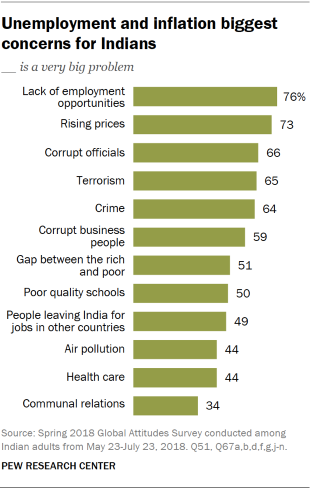
The table below shows the main concerns the voters have in their hearts and minds. Jobs remain a major issue. India has nowadays millions of young university graduates. But not enough jobs for them. Many end up by performing low-skilled and low-paid tasks. They feel very frustrated.
However, there is hope in the future. When I visited last time, after twenty years without being back, I found a country that is modernising fast and full of optimism.

Prime Minister Narendra Modi might win the elections this time again. He is seen as resolute, clear-minded. However, I think his approach towards the Muslim Indians is not appropriate. He puts too much emphasis on the Hindu side of the culture, forgetting that India is a multicultural society and that social peace can only be achieved by politics of inclusiveness. Let's hope he goes back to a more balanced approach once the elections are over.


Chart showing that unemployment and inflation are the biggest concerns for Indians.

Tuesday, 16 April 2019

The politicians and the armed forces


In the “old Europe”, from France to Germany and through the Benelux, the public opinion is very divided regarding the possible increase in military budgets. Half of the citizens agree with the increase; the other half is not convinced. 

This situation places the governments in a very delicate position. They are stuck. And they have not managed to address the security and defence issues with the right words. Politicians in several European countries are not clear about the military. Therefore, many people understand the need for more money to be spent with the police services, with the prisons. But they are not sure about the role of the armed forces.

Monday, 15 April 2019

Europe cannot burn like that


Notre Dame de Paris. A major symbol of the European culture. In flames. In front of our eyes. 
Devastated. What a tragedy.

And, in some sense, what a illustration of the fate of today´s Europe.

It must be rebuilt. Our culture and our history must fight back.

Sunday, 14 April 2019

Algeria and Sudan


Algeria and Sudan mean good news. It is so rewarding to have positive developments in these two countries. People are in the streets, fighting for democracy, after so many years of government brutality. And they are not ready to let change go and be just apparent. They want deep political reforms, serious constitutional changes. Civilian rule after the dictatorship of the intelligence services and the armed forces.

They will do it by themselves. There is no need for external pressure or interference. In both cases, we have populations that have shown political maturity and indomitable courage. They learnt, after so many years of hardship, to be strong and clear in their determination.

Saturday, 13 April 2019

Assange and the legality of some cover operations


Julian Assange’s predicament leaves no one indifferent, in our part of the world. He has scores of supporters. Also, plenty of detractors. His personality, not just his deeds, is deeply controversial. I will not enter that discussion.

However, I recognise that, thanks to his initiative, it has been possible to demonstrate that a good number of actions taken by powerful Western governments, under the cover of national security and defence, surpassed the limits of what can be considered legitimate. Basic rights and values have been shaken by such actions.

And that brings back a fundamental question that remains unresolved in our democracies. The systems in place do not ensure a proper democratic, ethical and legal control of some undercover operations carried out by special military forces, or by specific police and intelligence services within the security apparatus. It has become obvious that our parliaments are not prepared to exercise such oversight. They intrinsically lack the competence and the political strength to carry out that role. And the justice machinery is basically in the same position of weakness.

I think it is time to envisage the creation of a constitutional body that would bring together a small number of elders, a group of sages who have reached the end of their professional ambitions and careers, and have behind them an immaculate life history, a public image of great credibility. This would be a top-level group mandated to oversee and assess complex legal and ethics practices as carried out by special government agencies. Such independent panel would report to an appropriate parliamentary committee.

This move would certainly respond to some key interrogations that we ought to deal with, based on what Assange and Wikileaks have revealed.  


Friday, 12 April 2019

Assange and the law


Julian Assange has a long legal battle in front of him. The decision about his fate must be based on the law. But his case has so many political ramifications that it will be difficult to separate the legal aspects from their political context. It will be a very controversial process.

Thursday, 11 April 2019

Estonia's turn to the far-right


We do not pay too much attention to politics in Estonia. The received wisdom, in Brussels and in the Western part of the EU, is that the country is doing well and springs as an example of e-government and the connected society.

But these days, there are some less tranquilising news coming from Tallinn. The Prime Minister’s Centre Party, a member of the centre-right European family, has now decided, against all pledges, to establish a governing alliance with the extremists on the far-right and offer them five Cabinet positions.

EKRE, that’s the name of the extremist party, is not good political company. Some of its banners are inspired by white supremacist ideas and old-time national-socialist nightmares. 

Estonia is following the same path Austria has already taken. And others. That is certainly not an encouraging development for the rest of the EU. It shows the populists keep gaining access to power in different corners of the Union. European leaders cannot remain silent when these types of coalitions are put in place.  


Wednesday, 10 April 2019

Brexit is in town


Brexit night, again, here in Brussels. Theresa May wants a short postponement of her country’s Brexit date. That is certainly something that would make sense, now that her government and the Labour Party are engaged in talks. EU leaders could wait for those talks to conclude, be it that in the end there is no agreement between the two sides. The position could stand as a recognition of the merit of such talks, an invitation for a national decision on a matter that is of crucial importance to the British nation.

That would be my position in today’s summit meeting. Such position would give the UK Prime Minister some political strength, at a time when she is very weak, it would show respect to her and it could be supported by the European public opinion.

Tuesday, 9 April 2019

Europe and China: let's be constructive


The EU and China have their annual summit in Brussels today. The preparatory work has shown that Europe is now prepared to have a firmer position in matters of trade, investment and protection of industrial patents and copyrights. That is the right approach for the economic relations between both sides. Beijing might not like it, but they understand the rationale behind the European position. They fight for their interests, and we should fight for ours. That is the only basis for a sound relationship between two major international players.

When dealing with China, the EU must remain united around the principles of reciprocity, fair competition, and respect for the natural environment.

The Europeans have also to consider that we are dealing with State capitalism at its strongest form. Behind each big corporation, there is the Communist leadership of China and their concern with their own survival as a regime. For that, they need to expand the Chinese economic interests abroad, control new sources of wealth in foreign lands, and bring back prosperity to the people of China. Europe is a special land of business opportunities, an attractive economic space for big investments. That’s fine, if the basic international rules are respected and the link between each side is open to accept traffic on both directions.

Above all, the Europeans must keep in mind issues of national security. As far as we are concerned, China is a partner with greater potential for business but is also a first-grade geostrategic player. We must be able to keep our strategic sectors under our own control. That will contribute in no small manner to balance the geopolitical power of our Chinese neighbours. The world needs our contribution to the balance. Europe’s big challenge, in this area, is to remain a strong pillar of international wisdom.