Showing posts with label economic growth. Show all posts

Friday, 19 June 2020

We are going back the big way


If I had to select a piece of today’s news, I would go for the WHO Director-General’s warning that the pandemic is still growing in many parts of the world. It has now reached every nation. Many countries are now at a standstill. In some of them, even internal travel is not allowed.

Poverty is expanding rapidly in developing countries. The world is losing what it gained in decades of development assistance. It hurts to acknowledge such a fact, particularly for someone who spent decades in the development line of work. The only hope is that once the pandemic is under control the know-how that has been created in those countries all these past years will be mobilised for a quick recovery. For that to happen, those countries will need major capital injections. The international institutions will have to be the key advocates of such assistance.

Friday, 15 May 2020

Power and dominance


In responding to a friend that lives in China, I said I am also genuinely concerned regarding the growing tension between his country and the US. We do not believe there will be, in the foreseeable future, an armed confrontation between these two powers. We both know that today's wars are fought in diverse ways, but no longer through the classical approach of bullets and boots on the battlefields. Big countries make use of other means to disrupt and weaken the adversaries. The armies are for smaller fights and to show off. We live in a more civilian world, and we fight with a variety of tools that are available in a multidimensional toolbox. Such means can be very destructive as well, with a wide impact on a number of the things, including on the livelihoods of many people.

And this time the conflict is not about ideology, like during the Cold War, but about what each side sees as its vital national interest. In addition, history has taught us that the dominant power perceives the emerging power as a major menace. That is the trigger. And all this makes the confrontation move way up to a more dangerous level, more multifaceted and certainly far more complex to mediate. Moreover, it brings in other countries that have no choice but end up by being forced to take sides. They will also be dramatically affected by the dispute.

In such a dangerous context, my view is that we should keep talking about international norms and cooperation, as well as about clairvoyant leadership. In all truth, the leadership thing is the key issue. It can bring us back to a more reasonable world or take us to the abyss.

Wednesday, 13 May 2020

Five fundamental questions


As I see it, there are five big questions on our European table. One, how to strike the balance between public health and the health of the economy? Two, what role should each State play and what are the limits the governments should not overstep? Three, what kind of societal changes should be promoted for a better type of human society in the post-Covid era? Four, what about the implications of this extraordinary crisis on the future of the European Union? And five, what will be the new shape of globalisation?

These are the key lines of reflection as we look ahead. The debate about each one of them is open. It is a complex one but must be conducted. The depth of the current crisis calls for a complete review of the way we have been doing business. Those who think that we just have to press the recovery button, and everything will be back to what we had in January are wrong. We are not going back.

Sunday, 9 February 2020

A New Green Deal


Economic growth cannot be achieved at any cost. In today’s world, the impact of production on environment must be part of the calculations. Growth that deteriorates the environment, that increases the CO2 emissions, that is artificially supported to keep quiet some sectors of the electorate – the EU agricultural policy is the best example of distorted and wasteful growth, and we are talking about billions of euros every year  – all that should be considered negative growth and accounted for as such. 

Almost 30 years ago, the UN Development Programme (UNDP) came up with the concept of human development. This model was much more inclusive than the old notion of economic growth. It included more than just the production of additional goods and services. It was an approach designed to add to the response to the basic needs of a population other essential dimensions that would bring social peace, equality of opportunities and people’s creativity and dignity. And gradually, it also incorporated the judicious use of natural resources and the environmental dimensions. We tried to resume it under the designation of sustainable growth, but it was more than that. There was a strong human security aspect in it as well as a resource sustainability dimension.

In many countries, lots of people have been brought out of poverty during the last three decades as well. But the environmental dimension was kept aside, not considered when planning and opening new economic avenues. And if we travel to India or China, we can immediately understand the costs those societies have to pay for not paying attention to the natural context.

The problem is that natural phenomena do not respect national borders. What starts as a national problem ends up by being an international issue. That’s what the Paris Climate Conference of 2015 tried to put on the table. Global matters require concerted international efforts. 

In terms of urgency, it is obvious too many of us that economic expansion cannot bring additional CO2 on a net basis. There is a need to mitigate and to compensate. These two words should guide the way we look at the production, distribution and consumption of goods in the future. The new economy should be about proximity, mitigation, compensation and substitution. These areas offer immense opportunities, both in terms of business and jobs. They allow us to put GDP in the shelf where history keeps the past events and imagine a new Green Deal. That’s the one of the most immediate challenges.   


Wednesday, 17 April 2019

Indian elections and the need for balance

India is voting for a new Parliament. That’s a gigantic exercise, with over 900 million people on the voters ‘roll. It takes over five weeks to complete. But people trust the electoral authorities and that’s very good news. India’s electoral commission is an example to be followed by many developing nations. Particularly if one considers that the Indian political class is seen as very corrupt. There is a difference between the politicians and the senior civil servants. Functionaries are well prepared and very professional in the performance of their duties. And that’s why the electoral system is trusted. There is no political influence in the system.

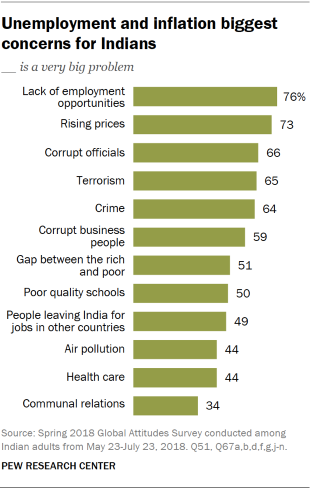
The table below shows the main concerns the voters have in their hearts and minds. Jobs remain a major issue. India has nowadays millions of young university graduates. But not enough jobs for them. Many end up by performing low-skilled and low-paid tasks. They feel very frustrated.
However, there is hope in the future. When I visited last time, after twenty years without being back, I found a country that is modernising fast and full of optimism.

Prime Minister Narendra Modi might win the elections this time again. He is seen as resolute, clear-minded. However, I think his approach towards the Muslim Indians is not appropriate. He puts too much emphasis on the Hindu side of the culture, forgetting that India is a multicultural society and that social peace can only be achieved by politics of inclusiveness. Let's hope he goes back to a more balanced approach once the elections are over.


Chart showing that unemployment and inflation are the biggest concerns for Indians.

Monday, 4 March 2019

Macron and his European vision

This evening, the French President addressed a message to all Europeans about the future of the European Union. It's a very clear agenda for action. And a strong signal that the EU calls for leadership and renewal. A warning, in many ways, but with militancy and optimism.

The message can be read in English in the following site:


https://www.elysee.fr/emmanuel-macron/2019/03/04/for-european-renewal.en

Saturday, 25 March 2017

EU at Sixty

The EU leaders today met in Rome to celebrate the 60th anniversary of the common European political dream. And they approved a Declaration to charter the way for the next ten years or so. In my opinion, the most salient point of this initiative is about unity. The leaders have shown they believe in the joint future of the EU Member States. They are particularly keen about strengthening the Euro, as the Union's currency. And they want to focus their attention on four priority areas: security, economic prosperity, social protection and a more strategic presence in international affairs. It´s a good choice even if within each one of these areas there is still a need to be more precise, both in terms of narrowing down the areas to concentrate on what is indeed transformational and timelines.