Showing posts with label corruption. Show all posts

Friday, 12 February 2021

Discussing security and governance in the Sahel

In the Sahel, a lot of military and little politics

Victor Angelo


The call came from Bamako. On the other end of the line was a former colleague, now back home after a brilliant career in the United Nations. The essence of his conversation was against the massive presence of foreign troops in his country. There are more and more of them, both in the framework of the UN mission - known by the acronym MINUSMA - and due to calls by France. Contrary to recent statements by Emmanuel Macron, who said that the war against terrorism in the Sahel was being won, my friend told me about the deterioration of the situation in Mali and in neighbouring countries. In other words, there are more military personnel but, paradoxically, less security.

Let us look at the latest statistics from the International Organization for Migration. They count about 1.7 million displaced persons due to instability and armed actions in this part of the Sahel, especially in the tri-border area between Mali, Niger, and Burkina Faso - a region known as Liptako. It is estimated, on the other hand, that about seven thousand lives were lost in the last twelve months due to acts of terrorism and counterterrorist prevention and response operations. These are figures well above the average of previous years. What is more, a recent United Nations investigation shows that war crimes and atrocities have been committed in Mali since 2013. The report, which in addition to pointing the finger at terrorists calls into question the armed forces of certain states, has fallen into a deep hole in the Security Council and awaits debate at the Greek calends. 

Liptako is a vast territory, with an area where Portugal could fit three times over. The Fulas, as nomadic herdsmen and itinerant traders in long caravans, have traditionally shared these dry, harsh expanses with other ethnic groups. But ways of life have changed. Accelerated population growth in recent decades, coupled with enormous pressure from cattle rearing - a multiplication of herds -, increasingly irregular and scarce rainfall due to climate change, poverty and the absence of effective state administration have contributed to a widespread environment of social instability, rebellion and conflict. The rush for gold, which began to be exploited intensively on an artisanal basis some twenty years ago, has also attracted new waves of violence. This is the framework in which various armed gangs move and operate under the confused banners of the terrorist network of the Islamic State in the Greater Sahara (ISGS) or, further north, on the way to the border with Algeria, the people affiliated to Al-Qaeda. Religious fanaticism serves as an excuse or muddles along with banditry. For many young people, the Kalashnikov has replaced the shepherd's stick or the farmer's hoe in a context that is becoming progressively more arid, unpredictable, and dangerous. Someone from the region told me that joining an armed group is for many an act of self-protection.

There is a huge problem here that fundamentally requires two types of approach: one will be political and the other will be to combat desertification and poverty. I will mention only the political part, which requires the inclusion of all, without discrimination on ethnic grounds. It also means publicly showing a firm hand against corruption, in military institutions and state administrations. Inclusion and probity are two fundamental issues, which must be resolved by national elites.

 The European partners have closed their eyes and pretended not to see these problems. For example, they have been training officers in the Malian armed forces for years, knowing fully well that these officers have kept a tribal mentality and systematically divert resources intended for the country's stabilisation effort to their own advantage. We need to change the way we act in the Sahel. Dialogue with the countries in the region must be respectful. The future that is at stake is theirs, independently of the external dimensions. We cannot take the direction of the process away from them. Being more papist than the Pope in other people's land is a practice that must be put away once and for all, in a drawer of the past. But it must be a frank dialogue.


(Automatic translation of the opinion piece I published today in the Diário de Notícias, the old and prestigious Lisbon newspaper)


Saturday, 12 September 2020

On Mali and the region


In today’s Diário de Notícias (Lisbon)

Notes on Mali

Victor Angelo


Mali is a fascinating country, diverse in its landscapes and cultures. It is home to great singers and traditional musicians who play the korah, an ancestral instrument made from a large gourd, the Dogon masks and statues, birthplace of the city of Timbuktu, a unique historical reference in Islamic studies. For four centuries, until 1670, Mali was the epicentre of a great empire in West Africa, an empire recognized by Portuguese explorers, who traded extensively with it across the Gambia River. I would also add that I had several Malian colleagues at the UN who proved to be excellent professionals and held important positions in the different multilateral organizations. I write this to fight the summary opinions of those who are in the habit of arranging everything African in a dark corner, in the shadow of the usual prejudices. I am sad, like many others, when I see the country tearing itself apart and becoming insecure, as it continues to do daily.

Mali has made the news again in the last three weeks following the military coup of August 18. It is, for the same reason, the subject of debate, including in European circles. Moreover, some conspiracy theorists have seen Moscow's hand behind the colonels who took power, a hypothesis I consider unlikely. But there are other hands at work in Mali, from France to Saudi Arabia, and with vastly different intentions.

Also, at stake is the role of the United Nations, which has maintained a peace mission in the country since 2013, with more than 15,000 elements. MINUSMA, as the mission is called, has, over time, become a case study because it has not been able to respond to the political and governance issues that are at the heart of Mali's problems. The political direction of the mission resolved, to please the French and out of strategic opportunism, to stick to the president that the coup has now deposed. In New York, at the Security Council, no one had the courage to correct this trajectory. Thus, credibility is lost, and the future is mortgaged. 

Returning to the current debate, it should have emphasized that more than two thirds of Mali's population is under 25 years of age. And that education and the economy are unable to meet the challenges that such an age pyramid entails. When I was in Mali for the first time in 1990, its total population was around eight and a half million. Today, thirty years later, it is close to twenty million. The same happens in the other countries of the region. They all have explosive age pyramids. Demographic pressure has grown throughout the Sahel along with the advance of desertification and poverty. Being young in the Sahel means looking to the future and seeing only a multitude of arid politics, a desert of opportunities and a chaotic and inhumane urban habitat. Thus, hope and social peace are hard to achieve. All that remains is migration to Europe, or else adherence to armed banditry and fanatical rebellions. Fanaticism has grown exponentially over the past decade, thanks in particular to the proliferation of mosques, Wahabist koranic schools and radical preachers, all financed by the Saudis and others of the kind. 

Those who neither emigrate nor join the extremist groups, vegetate in the big cities, where they can observe how social inequalities have become blatant, the fruit of the corruption that prevails in political circles, in the security forces and in the administration of justice. They also see that European countries and other international actors turn a blind eye to the manipulations practiced by the powerful. This is what happened in Mali. After months of popular protest against the indifference of the president and the greed of his own circle of friends, a group of senior officials decided to act. They have popular support, at least for now. It is true that one should not support anti-constitutional coups. But it is also true that one can no longer pretend that one does not see corruption, ineptitude and the failure of territorial administration, with vast areas of national space without any state presence. The mitigation of crises begins with the promotion of probity and the restoration of local power, beyond the treatment of youth issues. This is what we must remind the colonels, the leaders of the region, the UN Security Council and the European partners of Mali, Portugal included. 


Sunday, 19 January 2020

Large-scale corruption


Today’s revelations about Isabel dos Santos, the Angolan entrepreneur and the richest woman in Africa, just confirm a few things I keep repeating. 

First, dictatorship and high-level corruption go hand in hand. 

Second, corruption is the key impediment of development and human security. 

Third, European leaders know that corrupted practices are widespread in non-democratic regimes, but they quite often prefer to turn a blind eye on the issue, if there are political or economic interests at play. 

Fourth, global consultancy firms do not mind offering some cover to illegal transfers, if there is money to be made from that. 

Fifth, an independent media is essential to uncover malpractices. And to keep dictators on guard, under watch. 

Wednesday, 20 November 2019

A global wave of urban revolt


It cannot escape one’s attention that currently there are several cases of urban revolt taking place in a good number of countries. Each one of these mass movements have their own specific causes. But I think there are a few common features. They are related to the stress of leaving in megacities with poor infrastructure and high cost of living, housing challenges, youth unemployment, job insecurity, and the disparity of living standards one can find in every big city. Inequality and a strong feeling of social injustice combined with scot-free corruption by the elites lead to mass demonstrations, including the destruction of symbols of power.

Tuesday, 8 October 2019

Fighting corruption


Widespread corruption remains a major issue in some developing countries. It cannot be absent from the policy dialogue with our partner countries. It must be a very central topic and our common responsibility is not to run away from the issue. Diplomacy is no justification to ignore the fate of the populations that see their economy being capture by a few members of the political leadership.

Today, I had a long discussion about the matter and how it affects equitable growth and the fight against poverty. The starting point was the current situation in Zambia. And I was sad to note that I have seen better governance in that country. And unfortunately, it is just an example.

Sunday, 21 April 2019

Volodymyr Zelensky: the people's choice


Volodymyr Zelensky, a comedian and a man of the people, has won the presidential elections in Ukraine. This is no small victory. It is a landslide, with about 73% of the votes in his support. It is above all the expression of a very deep frustration regarding the political elites and their inability to address corruption, poverty and conflict with Russia.

The people has spoken, and their choice is clear. Let’s hope for the best. One should see this result with some optimism.

Wednesday, 17 April 2019

Indian elections and the need for balance

India is voting for a new Parliament. That’s a gigantic exercise, with over 900 million people on the voters ‘roll. It takes over five weeks to complete. But people trust the electoral authorities and that’s very good news. India’s electoral commission is an example to be followed by many developing nations. Particularly if one considers that the Indian political class is seen as very corrupt. There is a difference between the politicians and the senior civil servants. Functionaries are well prepared and very professional in the performance of their duties. And that’s why the electoral system is trusted. There is no political influence in the system.

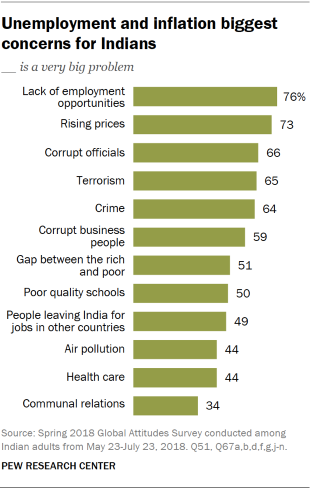
The table below shows the main concerns the voters have in their hearts and minds. Jobs remain a major issue. India has nowadays millions of young university graduates. But not enough jobs for them. Many end up by performing low-skilled and low-paid tasks. They feel very frustrated.
However, there is hope in the future. When I visited last time, after twenty years without being back, I found a country that is modernising fast and full of optimism.

Prime Minister Narendra Modi might win the elections this time again. He is seen as resolute, clear-minded. However, I think his approach towards the Muslim Indians is not appropriate. He puts too much emphasis on the Hindu side of the culture, forgetting that India is a multicultural society and that social peace can only be achieved by politics of inclusiveness. Let's hope he goes back to a more balanced approach once the elections are over.


Chart showing that unemployment and inflation are the biggest concerns for Indians.

Wednesday, 20 March 2019

Europe and Africa


In my discussion today with senior EU officials, I asked them  to take home 7 major issues:
1.     Population explosion
 .   State legitimacy and Human Security
3.     Understanding State Fragility
4.     Livestock: do not leave behind the shepherds
5.     The Dragon has a plan: China in Africa
6.     Dialogue, dialogue, dialogue, supported by the EU and Member States diplomatic / trade / security machineries
7.     Tell the story: keep repeating the appropriate narratives. Be frank and positive


Tuesday, 14 February 2017

Romania´s street lessons

The people of Romania have been demonstrating on the streets for the least 15 days or so. The rallying cry is against official corruption, the abuse of power the elected authorities exert for their own advantage and enrichment. And there are plenty of cases: thousands of accusations have been made by the special prosecutor and her office since 2013. People want the current government, led by the Social Democrats to leave office. This government has tried to save from the justice quite a number of past politicians who have been accused of corruption.

As I see the masses on the streets, braving the extreme weather conditions, I come to the conclusion that a number of points should be underlined. They must make us think.

The prosecution is headed by a very brave woman, Laura Codruta Kovesi. She is in charge of the anti-corruption agency, which comprises a good number of young lawyers and prosecutors. Kovesi has shown that leadership, honesty and modesty can change a country.

The political parties have no role in the popular mobilization. They have been side-lined, overtaken. This is civil society in action. There are no stars, no street leaders. It´s citizen’s power at its best.

The traditional media has also been overtaken. The information is shared through social networks. It´s faster, free of charge, and much more creative and closer to the people´s concerns. The established press comes later, just to pick the information and report about the events. But plays no role in the heat of the action.


Many of those on the streets are young people with a good level of education and a higher level of social frustration. Their participation creates some hope that change might happen. 

Wednesday, 31 August 2016

Brazilian politics

Dilma Rousseff´s impeachment might be seen from different partisan perspectives. Fine. But my point is a different one. It´s about constitutional processes. And her trial by the Senate followed the procedures established in the Brazilian Constitution. The debate was not always serene and had a number of much undignified moments. Yet, in the end, it was democracy in action through institutional mechanisms.


On a different point, let me refer that some of the Senators and other top political actors might not be an example of probity. There is plenty of corruption within the party machineries. That should be the next political challenge for the people of Brazil. If that is tackled with steadiness the poor citizens, that have been the main support of Dilma and her movement, might become more inclined to accept the impeachment decision of today. It is therefore time to speak about launching a laundry political process.  

Friday, 13 May 2016

Still on corruption: aid transparency

Aid transparency ranking:


Data compiled in the Aid Transparency Index and released by Publish What You Fund in April 2016.

Only 10 donors, responsible for only a quarter of all aid, are hitting the mark in terms of transparency of their funding programmes. We know that transparent aid flows do significantly contribute to increase accountability in recipient countries. And we also have spent the last 25 years listening to excellent lectures on good governance, as delivered by excellent representatives from donor countries and agencies. 

I believe the table speaks for itself. 

Thursday, 12 May 2016

The powerful smell of corruption

Today´s Anti-Corruption Summit brought together a few political leaders and some NGOs. 

David Cameron, the convener of the meeting, says the gathering has been a success. I would not go that far. He might have obtained some domestic gains out of it, I would not dispute that. However, I would also add the summit was simply one more step towards a more transparent international order. 

But we are still far away from the goal. It would be a serious mistake to try to fool ourselves about this. Many countries are led by extremely corrupt political elites. Those elites might have paid some attention to the final communiqué of today´s meeting. They will keep a close eye on the implementation of the conclusions. But they know they have many alternatives besides London. Including in other parts of Europe, of course. 

Tuesday, 15 March 2016

Brazil: moving fast in the wrong direction

The political crisis in Brazil is deteriorating fast. President Dilma Rousseff´s decision to appoint former head of State Lula da Silva as a senior Cabinet minister has contributed to a new level of malaise. People cannot understand this attempt to extract Lula from a regular judicial scrutiny.

And there are new revelations about corruption within the inner circle of power.

The pursuit of the impeachment process is now more likely. And we can also expect some additional desperate moves from Dilma´s side.

All this will bring additional deep fractures among Brazilians and further economic difficulties. The country will be in a very bad shape at a time it should be at its best to host the Olympic Games. But that´s only a lesser detail. The true challenge will be to repair the great damage that all this corruption will cause to Brazil´s self-respect and its international image. 

Thursday, 28 May 2015

The ugly face of FIFA

In addition to everything that has already been said by many in the media about the corruption scandal at FIFA, I would add a little question tonight: how can the Swiss authorities explain their want of investigative action against the FIFA´s leadership?

It is a bit difficult to see the US judicial system moving, and striking, and notice, at the same time, that there was no real investigation by the Swiss, notwithstanding the fact that this world football association has its headquarters in Switzerland.


I can´t believe the Swiss prosecutors were not aware of the strong stench coming from the FIFA building. 

Sunday, 8 February 2015

On Brazil again

Returning to theme of yesterday – Brazil – I should add that in addition to the corruption issue, that is undermining the credibility of some political circles, there is a serious problem of deep social disparities.

Many Brazilians live a very tough live and their children have few chances of getting out of the social swamp because they are not proper schooled. Education for the very poor is still a major challenge. The ruling Workers ‘Party has helped the poor, but the policy of money grants is not sustainable.

Then, on the other side of the class ladder we find people that enjoy all pleasures of life and can afford a standard of living that is comparable to the best in the world.


It is the middle class that is being squeezed out. The cost of decent housing and other expenditures have increased dramatically during the last few years. Some costs are far higher than in Europe. 

Therefore, it is no surprise to see that the main activism against President Dilma comes from people belonging to the urban middle classes. She is actually losing ground fast within this social group. 

Saturday, 7 February 2015

Corruption in Brazil´s leading circles

I had a long conference call with a Brazilian friend who lives in Rio de Janeiro. And I could realise how much the Petrobras corruption scandal is eroding the foundations of President Dilma Rousseff´s power. It is also exposing her natural tendency to micromanage everything that counts, instead of letting the institutions and the procedures do their work. She is in serious need of sound advice. But is she able to listen?

Monday, 10 November 2014

Nigeria is being destroyed as a result of many years of corrupted practices

A large number of school children were killed today in North-east Nigeria by a suicide bomber. It was another tragedy in a country that is a key target for extremists.

I feel very sorry for the people of Nigeria. But not just because of the mass killings. Also because the widespread insecurity is the tip of a huge iceberg, made of large-scale corruption. Plenty of money has been spent on the armed forces and the police and these institutions are as weak as the rest of the public services. A good chunk of the resources was wasted and misappropriated.

 Institutions have just become facades, nothing else. That´s why Nigeria, which has a very big military establishment, cannot deal with Boko Haram. If one takes into account that Boko Haram and the extremists are just a bunch of unsophisticated terrorists one realises better the measure of the inefficiency that has resulted from many years of corrupted practices at very high levels of authority. 

Saturday, 12 July 2014

Insecurity in the Gulf of Guinea: where are the root causes

At yesterday´s international meeting on Security in the Gulf of Guinea, convened by the Portuguese Ministry of Foreign Affairs, I built my intervention five security dimensions that are critical to understand the root causes of the challenges the region is facing.

They are:

          Widespread poverty, desperation, shrinking opportunities for survival –example, less fish available to the coastal communities – , advancing desertification, over-grazing and community conflicts, high cost of living; this is the livelihood dimension.


          Very high rate of population growth, domestic migrations, rapid urbanization, transfer of poverty to the cities, youth unemployment, marginalization and urban crime, armed gangs; the demographics dimension.

          Extremely weak State institutions in all sectors, including in the areas of national and domestic security; this is State ineffectiveness dimension.

          Governance and democratic deficits, human rights violations, widespread corruption and ineptitude, predatory elites; this is the governance dimension.

          Radicalisation and simplification of the political-religious discourse; the influence of radical preachers trained in and funded by Middle Eastern Countries; the identity and ethnicity as instruments of power and exclusion; this is the extremist dimension.

Wednesday, 4 June 2014

Our attention lost sight of the Boko Haram girls

Boko Haram is still very much alive and kicking. They keep attacking civilians in Northeast Nigeria and making sure everybody understands that the federal government is just composed of a bunch of inept political opportunists. The school girls are yet to be freed. And the international security teams that came to help are now realising that corruption within the armed forces of Nigeria is a major handicap. A few generals have now been accused of selling weapons to the armed extremists. But that´s not enough to turn things around. And the world has lost sight of the girls and the extremism and moved its attention elsewhere. 

Monday, 31 March 2014

Time to re-engage Erdogan

Erdogan´s party has added another electoral victory to its prize list. A large number of the voters have gone for stability and economic growth, the two flags associated with the Prime Minister’s leadership. One has to respect the Turkish people´s choice.

But Erdogan has also to realise that those who have voted against him, and they are more than half of the population, also call for respect. They are no traitors. They just happen to be young, better educated, urban based, and people that value the right to have a different opinion about the governance of Turkey. They also aspire for a government that is ready to effectively fight corruption and power abuse.

The fear is that Erdogan will read into the results a license to be harder on the opponents.

That´s why the leaders of the EU have to re-open the political dialogue with him. That´s the way to a more tolerant leadership in Turkey.