The
US Government’s decision not to renew the waiver given to China, India, Turkey,
Japan and two or three more countries regarding the purchase of Iranian oil is
very extreme. This basically means that any country buying Iranian oil after
May 1 might find itself sanctioned by the Americans. In the tradition of
international relations, such decision is equivalent to an act of war against
Iran and a hostile move against the countries that import petroleum from Iran.
It is a matter of great concern. It must be seriously debated.
Monday, 22 April 2019


Sunday, 21 April 2019
Volodymyr Zelensky: the people's choice
Volodymyr
Zelensky, a comedian and a man of the people, has won the presidential elections
in Ukraine. This is no small victory. It is a landslide, with about 73% of the
votes in his support. It is above all the expression of a very deep frustration
regarding the political elites and their inability to address corruption,
poverty and conflict with Russia.
The
people has spoken, and their choice is clear. Let’s hope for the best. One
should see this result with some optimism.
Poor Sri Lanka
This
Easter Sunday has been a sad day for humanity. In Sri Lanka, barbarians planned
and executed a series of terrorist attacks against innocent people in churches
and hotels. Scores died and many were wounded. And the country itself, still
trying to find peace after so many years of a tragic civil war, has also seen
its image being seriously affected. Everyone should express deep shock and
strong condemnation of such violence.
Saturday, 20 April 2019
Easter and our history
Easter
is an essential part of our European culture. It is not necessarily about religion.
But it is certainly about our roots, history, traditions and the associate
narrative. And all that has nothing to do with bunnies and chocolate eggs. Let’s
not mix civilisation with cocoa.
Friday, 19 April 2019
Notre-Dame and the response of the wealthy
Many
people have shown sincere astonishment and expressed deep shock when told that
a small group of French billionaires and some big corporations have pledged
close to one billion Euros to finance the restoration of the Notre-Dame
Cathedral. People compare such largesse to the poor response given to recent humanitarian
appeals.
The
gap is indeed abysmal and difficult to understand.
I
do not pretend to know the minds of the very rich. But I have met a few. And
they are indeed much more willing to give money to the arts, the protection of
the natural world, the advancement of scientific research, and other broad
issues than to alleviate poverty and address social issues like the plight of
the homeless or drug addiction. Patron of the arts is a tradition that comes
from the aristocratic times. It occupies a very high position in the status
ladder.
Moreover,
it is also my reading that many of those who became outrageously wealthy
believe that poor people are responsible for their own fate. They kind of share
the moral high ground those who have been successful in life love to place
themselves. From those heights, they look at everyone else as people who have
not been able to create their own life opportunities or have just accepted
their condition without fighting back. Many rich people – and I am only
referring to those who are generous enough to pay for big causes, I am not
talking about the greedy and the corrupt – are convinced that poverty is an
individual responsibility. They do not say it loudly. But they think people
should have tried harder. They also believe that the social security systems
are good enough to take care of those in dire need.
I
am not trying to justify their approach, please be sure of that. I am just
sharing an interpretation. My point is simple. If we do not comprehend the
reasons, we cannot contribute to a meaningful change of the behaviour.
Wednesday, 17 April 2019
Indian elections and the need for balance
India
is voting for a new Parliament. That’s a gigantic exercise, with over 900
million people on the voters ‘roll. It takes over five weeks to complete. But
people trust the electoral authorities and that’s very good news. India’s
electoral commission is an example to be followed by many developing nations. Particularly
if one considers that the Indian political class is seen as very corrupt. There
is a difference between the politicians and the senior civil servants. Functionaries
are well prepared and very professional in the performance of their duties. And
that’s why the electoral system is trusted. There is no political influence in
the system.
The
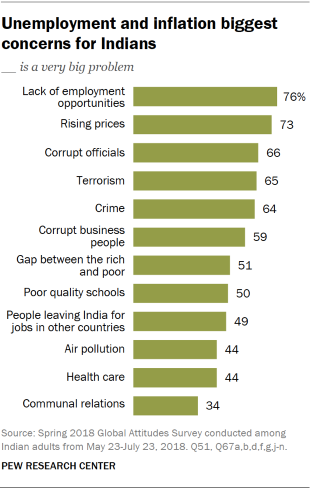
table below shows the main concerns the voters have in their hearts and minds. Jobs
remain a major issue. India has nowadays millions of young university graduates.
But not enough jobs for them. Many end up by performing low-skilled and
low-paid tasks. They feel very frustrated.
However,
there is hope in the future. When I visited last time, after twenty years
without being back, I found a country that is modernising fast and full of
optimism.
Prime
Minister Narendra Modi might win the elections this time again. He is seen as resolute,
clear-minded. However, I think his approach towards the Muslim Indians is not
appropriate. He puts too much emphasis on the Hindu side of the culture, forgetting
that India is a multicultural society and that social peace can only be achieved
by politics of inclusiveness. Let's hope he goes back to a more balanced approach once the elections are over.
Tuesday, 16 April 2019
The politicians and the armed forces
In
the “old Europe”, from France to Germany and through the Benelux, the public
opinion is very divided regarding the possible increase in military budgets.
Half of the citizens agree with the increase; the other half is not convinced.
This situation places the governments in a very delicate position. They are
stuck. And they have not managed to address the security and defence issues with
the right words. Politicians in several European countries are not clear about
the military. Therefore, many people understand the need for more money to be
spent with the police services, with the prisons. But they are not sure about
the role of the armed forces.
Monday, 15 April 2019
Europe cannot burn like that
Notre Dame de Paris. A major symbol of the European
culture. In flames. In front of our eyes.
Devastated. What a tragedy.
And,
in some sense, what a illustration of the fate of today´s Europe.
It
must be rebuilt. Our culture and our history must fight back.
Sunday, 14 April 2019
Algeria and Sudan
Algeria
and Sudan mean good news. It is so rewarding to have positive developments in
these two countries. People are in the streets, fighting for democracy, after
so many years of government brutality. And they are not ready to let change go
and be just apparent. They want deep political reforms, serious constitutional
changes. Civilian rule after the dictatorship of the intelligence services and
the armed forces.
They
will do it by themselves. There is no need for external pressure or
interference. In both cases, we have populations that have shown political
maturity and indomitable courage. They learnt, after so many years of
hardship, to be strong and clear in their determination.
Subscribe to:
Posts (Atom)