Showing posts with label Japan. Show all posts

Friday, 31 October 2025

President Trump in Asia: Power, Adulation, and the Rearrangement of Forces in a New Era

My geopolitical calendar differs from the conventional one. The twentieth century era, marked by two major wars, the Cold War, decolonisation, and large-scale industrial expansion, ended in 1991 with the collapse of the Soviet Union. That is when, in my reading of history, the twenty-first century began. We entered a period of economic globalisation, multilateralism and international cooperation, the development of democratic regimes, and a focus on sustainability and major global challenges.

My calendar also tells me that the twenty-first century was rather short. It seems to have ended with Russia’s brutal invasion of Ukraine in February 2022. Times changed then, with a return to former practices, the undisguised use of military and economic force as determining factors in international relations. At the same time, we have witnessed an accelerated race towards the future, driven by technological transformations and the digital revolution. The concern about inequalities between peoples has given way to insensitivity regarding development issues.

We are now in a strange and ambiguous period of universal history: we live simultaneously in the past and the future. We are connected by thousands of fibre optic cables and an increasing number of satellites. Global information is instantaneous, but it seems we are rapidly returning to old nationalist ideas, to every man for himself.

Indifference has become a distinctive feature of this new era. The excess of data ends up anaesthetising us. We become oblivious to what happens outside our immediate circle. This apathy makes it easier for populist, extremist political leaders to manipulate public opinion, using digital platforms to influence citizens’ behaviour. Paradoxically or not, the manipulators themselves end up listening to their own clamour and seem to believe the narratives they create. Thus, they fuel the cycle of misinformation and collective detachment from the major issues that remain unresolved.

In this context, commitment to critical thinking becomes fundamental. It is necessary to know how to question, analyse and interpret the intentions hidden in messages. Developing the ability to ask pertinent questions and assess the credibility of sources is essential to avoid manipulation and conformity. As Socrates argued 2,500 years ago, exploring alternative ideas and challenging established opinions is politically indispensable in a democracy.

This reflection originated from a recent comment made on one of our television channels about the new Russian nuclear-powered cruise missile, known in Russia as 9M730 Burevestnik and in NATO as Skyfall. Vladimir Putin announced that on 21 October the missile had been launched and that the test was a success. He added that the device had been airborne for 15 hours, covering more than 14,000 kilometres, and could therefore be directed at a target in the most remote corner of the planet. He also emphasised that no other state has the capability to intercept it. In other words, Russia was claiming to have taken another step towards consolidating its place at the forefront of the new era, the era of confrontation and force.

The commentator, a person I respect, said that Trump had “blithely” ignored Putin’s announcement. The reason for Trump’s indifference was missing.

I think it is relevant to try to understand this apparent disdain. I say apparent because yesterday the American president ordered his armed forces to begin a programme of nuclear tests, something that had not happened for more than three decades.

In my analysis, Trump, who has spent the week in Asia, is neither afraid of Russia nor particularly interested in Putin, except regarding the Russian war against Ukraine. He wants to add peace in Ukraine to his list of supposed peace treaties, always with the obsession for the Nobel Peace Prize. At this moment, today, Friday, he is convinced that Putin is the main obstacle to a ceasefire. Saturday, we shall see.

Apart from that, it has become clear in recent days that the absolute priority of the US administration is rivalry with China. His tour of Asia sought to demonstrate the influence and power of the United States in a region increasingly close to China. That is why Trump was in Malaysia, at the ASEAN summit, then in Japan, South Korea, and showed moderation at yesterday’s meeting with the Chinese president, Xi Jinping. In addition to trade agreements, several of them linked to cutting-edge technologies that will define the coming years, the success of Trump’s presence in Asia and the adulation he received reinforced his illusion that the US has decisive influence in that part of the globe. Putin’s missile, however powerful it may be—something yet to be confirmed—does not matter to Trump nor distract him, as he considers the fundamental priority to be relations with Asia, in the context of competition with China.

He makes, I believe, a superficial and mistaken reading of reality. He needs to understand that this new century, which began in 2022, seems to be heading towards the de facto consolidation of the strategic alliance between China and Russia.

Monday, 27 October 2025

Donald Trump's visit to Japan

Today's Trump’s return to Tokyo signals more than a diplomatic courtesy—it’s a calculated move to reassert U.S. influence in Asia amid rising regional uncertainty. It aims at showing American power and leadership in East Asia. 

His meeting with Prime Minister Sanae Takaichi underscores a push for a tougher stance on trade and security, likely aimed at countering China’s growing clout. While billed as alliance-strengthening, Trump's visit shows we are in a new era of transactional geopolitics, where economic leverage and strategic posturing dominate the narrative. As Trump emphasised, “the U.S.–Japan partnership must be stronger than ever to ensure stability and fairness in the region”—a clear nod to both security and trade dominance.

Saturday, 25 October 2025

Briefing Note: Russia’s Policies and Implications for APEC

Purpose

To inform APEC leaders of the strategic risks posed by Russia’s current foreign and economic policies and their potential impact on regional stability and economic cooperation.


Key Observations

  1. Militarisation and Geopolitical Assertiveness

    • Russia prioritises hard power over diplomacy, using the Ukraine conflict as leverage for global influence.
    • Increased military presence in the Arctic and Asia-Pacific signals readiness to escalate tensions, undermining regional security.
  2. Economic Weaponisation

    • Energy exports remain a geopolitical tool, with infrastructure projects used to divide allies.
    • Despite extensive sanctions, Russia sustains its war economy through alternative trade networks, deepening global fragmentation.
  3. Strategic Dependence

    • Russia’s “pivot to Asia” has led to structural reliance on China, limiting autonomy and raising long-term viability concerns.

Implications for APEC

  • Trade Disruption: Russia’s stance on sanctions and WTO mechanisms introduces friction into APEC’s consensus-driven model.
  • Security Spillover: Militarisation risks transforming economic forums into arenas of strategic rivalry.
  • Normative Erosion: Push for “multipolarity” challenges rules-based governance, creating uncertainty for smaller economies.

Recommended Actions

  • Reaffirm APEC’s Core Principles: Emphasise rules-based trade and economic cooperation.
  • Strengthen Collective Resilience: Diversify supply chains and enhance energy security to reduce vulnerability.
  • Engage with Caution: Maintain dialogue on economic issues while countering destabilising tactics through coordinated responses.

Bottom Line:
Russia’s policies combine revisionist geopolitics, economic opportunism, and strategic dependency. APEC must navigate engagement carefully to safeguard stability and uphold its mission of inclusive, sustainable growth.

Saturday, 11 October 2025

France, Germany and the European Union challenges and responses

 From France to Germany, and across the EU, the risks are enormous and the challenges must be won

Victor Ângelo

France is experiencing a very serious political crisis. The dissolution of the National Assembly, decided on 9 June 2024 by President Emmanuel Macron, was a gamble that surprised the political class and proved to be a mistake. Since then, four prime ministers have already come to power. The latest, Sébastien Lecornu, formed a government on Sunday night and resigned the following morning. An absolute record, which clearly shows the deadlock the country is in.

The political elites are grouped into two extreme camps: Marine Le Pen’s party and a coalition of more or less radical left-wing forces, with Jean-Luc Mélenchon as the leading figure. What little remains, the centre, is fragmented around half a dozen politicians who cannot agree. Several of these personalities, as well as Le Pen and Mélenchon, are convinced they could succeed Macron as head of state. They want Macron to resign from the presidency of the Republic without delay. Officially, his second term should end in May 2027. Now, due to the seriousness of the crisis, even his political allies are saying that the solution to the deadlock would be for the president to leave office early.

I do not believe this will happen. Macron may not want to admit that his popularity is at rock bottom. This week’s poll found that only 14% of the French support his policies. It is a catastrophic percentage. Macron believes, however, that he has the constitutional legitimacy to continue.

In a deep crisis like the current one, and if Macron were to opt again, in the near future, for early parliamentary elections, it is possible that Marine Le Pen’s far-right could win the most seats. Her party appears, to a significant part of the electorate, as more stable than the left, which is a fragile patchwork of various political opinions.

In any case, whether it is early presidential or new parliamentary elections, France is on the verge of falling into the abyss of deep chaos, caught between two ultra-radical poles. This time, the risk is very serious. The most likely outcome is that France, one of the two pillars of the European Union, will be led by a radical, ultranationalist party, hostile to the European project, xenophobic, and ideologically close to Vladimir Putin.

The other pillar of Europe is Germany. Friedrich Merz, chancellor since May, is in constant decline with public opinion. Only 26% of voters believe in his ability to solve the most pressing problems: the cost of living, housing, immigration, and economic stagnation. The German economy contracted in 2023 and 2024, with sectors such as construction and industry falling back to levels of the mid-2000s. The engine of the economy, the automotive industry, is about a third below its peak 15 years ago and has returned to levels close to the mid-2000s, reflecting a loss of competitiveness and profound structural changes in the sector.

In a recent discussion with German analysts, I was told that the unpopularity of Merz and his coalition is paving the way for the far-right to come to power in 2029 or even earlier. This year, the AfD (Alternative for Germany, a party led by Nazi nostalgists) came second, with almost 21% of the vote. The growing discontent of citizens, competition with the Chinese economy, tariffs and restrictions imposed by the Americans, spending on aid to Ukraine, Donald Trump’s blatant support for German right-wing extremists—who sees the AfD as a way to seriously undermine European unity—, the growing propaganda against foreigners living in Germany, all these are factors that reinforce the electoral base of this racist and Nazi-inspired party. Not to mention that the AfD maintains privileged relations with the Kremlin.

The crossroads in which both France, now, and Germany, in the near future, find themselves represent two enormous challenges for the survival of the EU. They are incomparably more worrying than the consequences of Brexit or the sabotage by Hungary’s Viktor Orbán and Slovakia’s Robert Fico. They come at a time when the EU faces a series of existential problems of external origin.

The external enemies are well known. Fear and concessions are the worst responses that can be given to them. Enemies and adversaries must be dealt with with great strategic skill and reinforced unity, only achievable if EU leaders can explain and prove to citizens the importance of European unity and cohesion.

The international scene is much bigger than the USA, Russia, or China. The expansion of agreements with Japan, Canada, Mercosur, the African continent, and ASEAN should be given priority attention. This list does not seek to exclude other partners, it only mentions some that are especially important.

The future also requires resolutely reducing excessive dependence on the outside in the areas of defence, technology, digital platforms, energy, and raw materials essential for the energy transition. Debureaucratising, innovating, and promoting the complementarity of European economies is fundamental. All this must be done while combating extremism. To think that extremists will play by democratic rules once in power is a dangerous illusion. Exposing this fiction is now the urgent priority in France, and the constant priority in all Member States, including Portugal.

Saturday, 13 March 2021

Comments on the Quad summit

Change course to avoid a collision

Victor Ângelo


The first Quad Summit, a new platform for strategic consultations between the United States, Australia, India and Japan, takes place today. Quad is short for quadrilateral. Since 2007, the foreign ministers of these countries have met sporadically to discuss the security of the Indo-Pacific region. This time, the meeting is at the highest level, albeit virtually, with Joe Biden and the prime ministers of the three other states.

The US President and Scott Morrison of Australia are the real instigators of this project. Narendra Modi and Yoshihide Suga were more reticent. They did not want the meeting to look like what it actually is: an avenue to discuss how to curb China's growing influence in the Indian and Pacific regions. So, the official agenda registers only three items - fighting the pandemic; economic cooperation and responding to climate change. This list thus hides the dominant concern, China's increasingly resolute power in both oceans and with the riparian states. China already has the world's largest armed fleet, with battleships, amphibious assault ships, logistics ships, aircraft carriers, polar icebreakers, and submarines. In the last 20 years, its naval capacity has grown threefold. It has more vessels than the United States and its ambition for the current five-year period (2021-2025) focuses on accelerating the production of means of ensuring presence and visibility, increasing missile capacity of distinct types and expanding nuclear weapons.  

The scale of these military investments and President Xi Jinping's very incisive foreign policy alarm many US strategists. It is in this context that the Quad summit should be seen. There are even those who think that, in time, Washington's objective is to create a defence alliance covering the Indian Ocean and the Pacific, in an arrangement that would be inspired by what exists in the North Atlantic, that is, the creation of a NATO of the East.

It will not be easy. India, notwithstanding the many border issues it has with China, does not want to be seen by Beijing as a hostile neighbour. It seeks, despite existing disputes, to maintain a certain diplomatic balance with the Chinese to moderate the latter’s support for Pakistan, which Indian leaders see as their number one enemy. Moreover, New Delhi wants to appear, not only to the Chinese but also to the Russians, as an autonomous defence power. Modi is a nationalist who knows a lot about geopolitics and international power play.

Japan, for distinct reasons, does not wish to enter into an open confrontation with China either. It will seek to continue to benefit from the American military umbrella, but without going beyond a prudent policy towards Beijing. Tokyo is banking more on mutual interests than on rivalry. And as long as Beijing does not try to capture the Japanese islands of Senkaku, long the object of diplomatic dispute between the two countries, Tokyo is unlikely to change its position.

However, the American strategy in this part of Asia is to create a containment front vis-à-vis China. If the Quad initiative does not work, they will turn to Europe, starting with NATO. This is where all this has to do with our security. I do not defend the idea of an alliance stretched to the ends of the earth, no matter how much Europeans see China as an unfair economic competitor or a state that does not follow the values we consider essential - democracy, freedom, and human rights.

The risk of an armed confrontation in that part of the world is growing. Europe's role must be to call for moderation, respect for international norms and effective dialogue between the American and Chinese leaders. The global challenges that the world faces today are already too many and require the building of a cooperation agenda between the great powers. And there, yes, they should be able to count on Europe's commitment.

(Automatic translation of the opinion piece I published yesterday in the Diário de Notícias, the old and prestigious Lisbon newspaper)


Monday, 6 January 2020

First step, to stop the escalation


The UN Secretary-General made a brief statement today about the current situation in the Gulf. I see the statement as important. We have reached a very dangerous crossroads. António Guterres’s message was about restraint, the exercise of maximum restraint. My call, following his appeal, is for countries such as Russia, China, Japan and the EU to seize Guterres’s words and repeat them loud and clear. They should also launch an initiative that would aim at freezing the situation as it is and, from there, try to establish a dialogue platform. I know it is not easy. But these are exceptional times. Those countries have the historical responsibility of making use of their influence. They should try to get both parties to the conflict to put a stop to escalation. That would be a first but important step. A most urgent step, for sure.

Sunday, 29 September 2019

Japan and the EU, on the same side


I am not sure that Friday afternoon is a good time for great political moves. At least, from the perspective of public information and support. The weekend is around the corner and the media tend to go slow. If they mention the action, it will be in a lazy line that gets lost fast. On Monday, it is already an old story. And it would have been overtaken by events happening during the weekly break.

The deal signed on Friday between the President of the European Commission and the Prime Minister of Japan seems to have fallen into this trap. Jean-Claude Juncker and Shinzo Abe put their signature of approval on an ambitious agreement that will see both sides cooperating in different parts of the developing world, including in the Balkans and other countries of Europe outside the EU, to build infrastructure and promoting digital industries. A lot of emphasis will be placed on thorough development projects, sustainability, transparency, national ownership and partnerships with the recipient countries and the appropriate multilateral organisations.

They called it a connectivity partnership between the EU and Japan. It can work, if we consider these are two of the largest economies. Together, they represent over 23 trillion US dollars of GDP, which is larger than the US ($21 trillion). And much bigger than China (USD 9.2 trillion).

The point is about politics. Both sides must make this cooperation a priority when dealing with developing nations. And they will be competing with China’s offer, the fast-moving Belt and Road Initiative. That will not be an easy competition. The Chinese leadership are deeply invested in the Initiative. To compete, the Europeans and the Japanese have no choice but to insist on projects that have the support of the populations – not just of the political leaders in the concerned countries – and are financially sound and proper. These are no technical or money matters. They are about strategic political engagements.


Sunday, 4 August 2019

Japan and South Korea


A couple of friends are not paying attention to the growing tension between Japan and South Korea. I am telling them this is a serious development. And that we must be talking about the matter with a louder voice.

 I know this is August, but there is no holiday taking place in that very sensitive part of the world. Japan does not like the way South Korea is approaching the North. They are also worried about South Korea’s policy towards China. However, above all, there are two major factors that make the mixture particularly complex: hard nose trade competition, as perceived by Tokyo, and old anti-Japanese sentiments that permeate throughout the Korean nation. 

All that are dangerous crisis factors. They would call for wise efforts from both sides. Unfortunately, we are far from that, at the present stage.  


Sunday, 21 July 2019

Hormuz: to avert further deterioration


As we start the last week of July, we must be profoundly aware that the situation around the Strait of Hormuz represents an extraordinary menace for peace and security in the region. In addition, if it escalates further it will have a serious impact on the economy of major international players, well beyond the region. Most of the oil the Gulf countries export – close to 85% of it – goes to major Asian economies, to China, India, Japan, Singapore and South Korea.

We need to see a major initiative launched with the objective of de-escalating the confrontation. It should come from the UN, if at all possible. If not, it could be initiated by the Prime Minister of India, Narendra Modi. His country has high stakes at play and, at the same time, has a voice that matters in the region and the UK.


Sunday, 30 June 2019

The Korean Day


Today’s front-page news is about the meeting between President Trump and Chairman Kim Jong-Un. And it can be summarised in two words: bold and positive. The US President takes a good chunk of the credit because the initiative came from his side. But the North Korean Leader – and the President of South Korea, Moon Jae-in – must equally be recognised.

Conflict resolution never follows a straight line. In the Korean case, after decades of confrontation and impasse, one should not be surprised to see the route following some unexpected turns. That was the case today.

Now, both sides have to transform the positive move they took into concrete negotiations and clear benchmarks. The benchmarks must be about confidence-building measures. They concern both Koreas and the Americans, above all. But they should seek to tranquilise the Japanese and the Chinese as well.

It would be a mistake to be over optimistic. But it would also be a serious failure not to accept that today’s event opens the door for serious discussions. The leaders have created hope. Now, they must sustain it.

Saturday, 29 June 2019

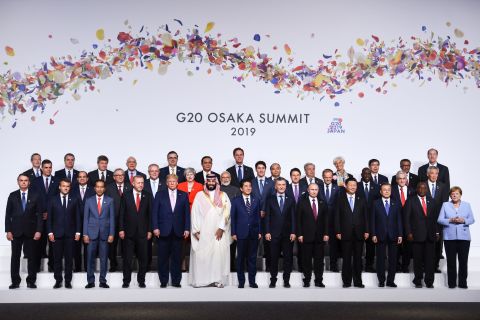
G20 official picture: the messages


Some people will spend a bit of their time reading the official picture of the 2019 G20 Meeting just held in Osaka. These types of pictures contain many hints. They cannot be taken lightly. The protocol and the political seniors of the host country – in this case, the Japanese who are masters in matters of meaning and symbology – invest a lot of working days deciding the positioning of everyone in the picture. Their final choice has a deep political import.

This year’s photo gives special attention to the Saudi Crown Prince Mohammed bin Salman. He stands at the centre, between the host, Prime Minister Shinto Abe, and the US President. We could think that such placing might be related to the fact that Abe is just back from a visit to Iran and he wanted to show that he also pays special attention to the diplomacy towards Saudi Arabia. Maybe he would love it to be interpreted that way. But it is just a happy coincidence for the Japanese. Abe is close to the Crown Prince because Saudi Arabia will be organising the next G20 Meeting, in November next year.

That’s the reason why the President of Argentina, Mauricio Macri, is also on the front row. The last meeting took place in his country (2018). That’s protocol.

Then, the rest of the front row brings together some of usual suspects: the leaders of China, Russia, Germany and France. But also, some special friends of Japan. First, two close neighbours, South Korea and Indonesia. And three other countries representing other regions of the world: Brazil, Turkey and South Africa. Surprising is to see Prime Minister Modi emerging in the second row. That’s not where India should be.

On the last row, a bit lost as he looks in the wrong direction, we can find the UN Secretary-General. This is not new. It has nothing to do with António Guterres. To place the UN boss in the background has been the tradition. I always thought such positioning sends a very inappropriate signal. The UN must be better recognised by the world leaders, particularly in a meeting that deals with global issues. It is important to battle for that.

In the end, my overall assessment of the meeting is positive. Many people might say these summits have no real purpose and are not useful. That’s a respectable way of looking at them. I want to take the opposite view, particularly in respect of this one. We are living in a period of tensions and great complexities. These leaders have the power to make it go in the right direction. They represent most of the world’s population and 85% of the global economy. When they meet and send some positive messages, the world feels a little bit more hopeful.


Friday, 14 June 2019

Hormuz tensions


Yesterday’s attacks on two petrochemical tankers sailing in the vicinity of the Strait of Hormuz should ring strident alarm bells. They make obvious there is a strong player that is betting on escalating the tensions in the region. And the fact of the matter is that we do not know who is playing such a destructive card.

We can try to guess based on a careful analysis of some nations’ strategic interests. However, at this stage to point the finger in one direction only contributes to augment the tension. It is certainly not the wisest approach. It should not be accepted.

The UN Secretary-General, António Guterres, should step forward and offer the organisation’s good offices to carry out an independent investigation of the incidents. The International Maritime Organisation could be part of it. In the meantime, he should dispatch a Special Envoy to the region. For instance, the UN Under-Secretary-General for Political and Peacebuilding Affairs. That move would help to lessen the regional political temperature.

Friday, 31 May 2019

A new EU leadership team


The challenge the EU leaders have in front of them is to make the right decisions regarding the key positions in Brussels and at the European Central Bank. The period ahead of us is most critical for the European Union. The only real choice we have is to consolidate the project. To make it stronger and better understood by the citizens, that’s what it means. Sensible people understand why we need a more united Europe. They know what is going on in some big countries and how those countries can be a major threat to us, if we do not have a collective response.

EU is big enough to be able to weather the storm we see in the horizon. It must count on itself. At the same time, it should look for alliances and balances of interests, with a clear and consistent policy line. That includes stronger relations with Canada, in the Americas, with key African countries, with India and Japan, among others.

But above all, it must win the support of the European citizens.

European politics are changing fast, both in terms of the issues and the actors. The heads of State and government cannot ignore those changes. When selecting the new institutional heads, they must take that into account. We need people that have the courage to face the new issues, know how to communicate, project confidence and empathy, and represent the different regions of our Continent.

Let’s hope the right decisions will be taken.

Monday, 22 April 2019

Iran and its oil


The US Government’s decision not to renew the waiver given to China, India, Turkey, Japan and two or three more countries regarding the purchase of Iranian oil is very extreme. This basically means that any country buying Iranian oil after May 1 might find itself sanctioned by the Americans. In the tradition of international relations, such decision is equivalent to an act of war against Iran and a hostile move against the countries that import petroleum from Iran. It is a matter of great concern. It must be seriously debated.


Saturday, 2 March 2019

Kim's vital agenda


You meet, negotiate and believe in Kim Jong-un at your own risk. And that’s a very high level of risk, I should add. Nevertheless, it must be done, and surely, with no illusion about the person who is sitting on the other side of the table.

Kim’s ultimate objective is to remain in power. He has no other option, if one considers the criminal and violent actions that he has behind him. Power means impunity. Absolute power means total impunity. In such circumstances, he is determined to decisively tackle anything that might challenge his goal.

I think he believes that the vital threat to his continued control of the North Korean system comes from the other side of the border, from South Korea. Not because of South Korea’s military might, no. It is because of the economic success and the type of society that South Korea represents. That, sooner or later, will end up by having a major impact on the attitude of the population in the North. It has the potential to be the key source of instability.  

Therefore, he wants to keep some kind of superiority vis-à-vis the South. And the only one he can bet on is on the military side. But for that, he must get the Americans out of South Korea. That’s what he is trying to achieve.

At the same time, he is also looking for an end to the economic sanctions. He knows that the sanctions bite. They make the comparison between the standards of living in the North and the South even more dangerous.

These are two elements that must remain at the centre of any future round of negotiations. And please, no illusions, no unnecessary warmth. 


Tuesday, 17 April 2018

Bringing the bullies together


When I scrutinise the foreign policies of permanent members of the UN Security Council I find no real differences, when it comes to the pursuit of their national interests. Each one of the five States is ready and willing to make use of force and go beyond the diplomatic conventions, tread into illegality, when its leaders think that the country´s national interests are at play. That´s particularly true for each country´s area of influence and strategic importance. It´s the case with China in the South China Sea, with Russia in Eastern Ukraine and Crimea, the US in Syria and Iran, the UK in West Africa and the Gulf Cooperation countries in the Persian shores, and with France in the Sahel Region of Africa.

The strategic options of these powerful countries take the primacy over the workings of the UN or other international organisations. It´s a fact, as well, that some of them do it more often than others. But when necessary, they will go for it. Norms and international law are to be respected as long as they do not collide with the views, ambitions and vital interests of the big five.

The primary role of the UN Secretary-General and other international voices, as well as the leaders of some key States such as India or Japan or South Africa, is to constantly recall the international norms and obligations. But it is also to look for points of equilibrium among the interests of the permanent members. Their critical geopolitical interests are known. The challenge is to negotiate taking them into account.


Wednesday, 5 July 2017

Kim Jong-un, a dangerous provocateur

Kim Jong-un is above all a provocateur. But a dangerous one, let's be clear. His repeated provocations have created a very delicate situation in his part of the world. And that's a complex region, at it's at the centre of fundamental geopolitical and strategic interests of very powerful countries.

In my opinion, he is not reading the current international situation with smart eyes. Political circumstances have deeply changed. As the intelligence about his most strategic means of power and military capabilities has also changed.


He still believes that China will shield him from any military action coming from outside. In addition, he is convinced that his threats of retaliation against South Korea will discourage others from intervening in the North. He might have a point. However, I am no longer sure that such point is strong enough. 

Sunday, 30 April 2017

Let the intelligence people do their work

The most dangerous mistake regarding North Korea could result from erroneous intelligence. It´s a real possibility. I know from a number of examples that intelligence agencies, even the best resourced and the most experienced ones, tend to make mistakes on critical matters. That´s particularly the case when they are under serious political pressure, as it is the case.

If the relevant intelligence people come to the conclusion that the North is about to launch some kind of nuclear or other threatening device, our side might then decide that the time for pre-emptive action is upon us. In these matters, decisions are taken fast.

Once they have been taken, it might be too late to contain and mitigate their multiple consequences.


Therefore, the first point in such a delicate situation as the current one is to make sure the intelligence work is carried out as professionally as possible, outside any type of political compulsion. Secondly, it is essential to fully consider the regional leaders ´opinion. Particularly, the South Korean ones, who are at present at the end of a decisive presidential campaign for an election scheduled for May 9. This is their region and in the world of today, their views are of paramount importance. 

Sunday, 16 April 2017

Our dear unpredictable enemy

There are a number of shockingly bizarre leaders and unacceptable governance regimes in the world. The North Korean one is certainly the strangest system. But, above all, it is a very serious menace to peace in the region, not to mention the human rights violations its citizens suffer on a daily basis.
It is also an extremely militarised country. By far, number one on this category. And on top of it, it is absolutely unpredictable.

The unpredictability is the main cause of deep concern in the region and also for the US, a country that has a strong strategic presence in the Korean Peninsula and in neighbouring Japan.


Today, the most pressing question is how to deal with such unpredictability. That´s what is under very active discussion in the special rooms where strategy is formulated. 

Monday, 6 March 2017

Time for some tough questions about North Korea

Kim Jong-un, the North Korean dictator, is a crazy man. But above all, as a political leader, he is tremendously dangerous. For his people and for the region. He controls an all-pervasive internal security apparatus, a machinery that makes everyone in country look either as mentally retarded or simply terrified. In addition, the tyrant spends most of the country´s limited resources on military hardware, including on expensive nuclear research projects for aggressive ends, and on an incredibly large number of troops, that make North Korea the most militarised country in the world. All this represents a major threat to peace in the region and gives rise to an arms race that includes Japan and South Korea.

The UN Security Council has approved a series of sanctions against the North Korean regime. But the man keeps provoking the international community. Today, it was the launch of four ballistic missiles into the Sea of Japan.

It is now time to make the sanctions more stringent. They should also be expanded. One area could be related to the international travel of the North Korean officials. Those movements should be made more difficult. And the 47 countries housing North Korean embassies should be advised to limit the privileges of the country´s diplomats.


North Korea must understand they have a choice. One option is to accept the existing international order and behave as a partner country. The other, is to continue the rogue policies of today and then face as much isolation and constraints as the international community can implement. And if such rigorous approach by the international community does not bring a change, then it is time to ask some tougher questions about the way we should treat a regime of such nature.