Showing posts with label António Guterres. Show all posts

Saturday, 21 May 2022

Looking at a possible UN role in Ukraine

UN: a roadmap for peace in Ukraine

Victor Angelo


More than a month has passed since an open letter was sent to the UN Secretary-General on the situation in Ukraine, signed by former senior officials. Meanwhile, António Guterres has been in Moscow and Kyiv, and has managed to push forward the UN humanitarian response. The political dimension, however, continues to be determined elsewhere. In general, words coming out of the West have been accentuating the possibility of a Ukrainian victory. Statements of this kind tend to aggravate the confrontation. It is true that there has been a considerable increase in arms support to Ukraine and that this is positive, as it allows for a redoubling of self-defence efforts. But in public, we should only talk about self-defence and, in tandem, the urgency of peace.

In this context, it makes perfect sense for the Secretary-General to stand up for a political process that recognises both the right to self-defence and war reparations, and the imperative of a peace agreement, guaranteed by the United Nations.

A new open letter should now insist on this line of action. A draft was prepared this week. I was one of those who found the text too vague, when the moment demands clarity and a firm assumption of responsibilities. So, for the time being, there will not be a new missive from us. The important thing is to show that the political pillar of the United Nations has the necessary authority to propose a way out of the crisis which will counter the escalation of military aggression and prevent the destruction of Ukraine.

The UN's political agenda could be built around four converging lines of intervention.

First, by seeking to establish temporary pauses in the fighting, in various localities deemed vulnerable, in order to protect civilians and facilitate humanitarian assistance. In this vision, the pauses would be monitored by a contingent of UN observers, with a mandate from the Security Council. The proposal to create a group of international monitors would be appreciated by many, although it is acknowledged that it would encounter immense obstacles to be approved.

Second, by maintaining a constant call, repeated until heard, for an end to hostilities and acceptance of a UN-led mediation process, which could include the preparation of a conference on a new framework for cooperation and security in Europe. 

Third, by continually recalling the Geneva Protocols on the limits of war. The major concern is the defence of civilian populations. Indiscriminate attacks are prohibited; acts of military violence to create terror are a war crime; infrastructures essential to the survival of communities must be spared; certain types of munitions are absolutely prohibited, including cluster bombs, chemical and biological weapons. It is also time to underline the rules on the treatment of prisoners of war, now that the defenders of the last stronghold in Mariupol have surrendered to Russian troops. This surrender is a highly political and symbolic event, which calls for a special reference, in defence of the rights of these prisoners. And of all the others, of course. 

Still under this heading, it seems essential to me to reiterate that the UN is already engaged in documenting possible war crimes and will seek, as far as possible, to increase its efforts in this regard.

Fourth, bearing in mind the divisions within the Security Council, and considering this war to be the greatest threat in 77 years, the Secretary-General could try to set up a Contact Group on the conflict. Such a group would bring together several influential countries that would be in constant liaison with Guterres in the search for solutions. It is a way to multiply the Secretary-General's capacity for intervention and to create a circle of support to protect him from political attacks. It would also show that the crisis has an international and not just a European scope.

None of this would be easy. But the fact remains that the job of UN secretary-general is anything but an easy one.

(Automatic translation of the opinion piece I published in the Diário de Notícias, the old and prestigious Lisbon newspaper. Edition dated 20 May 2022)


Saturday, 26 September 2020

Mr Trump speaks to the United Nations

This is the text I published today in Diário de Notícias (Lisbon newspaper). It is a machine (AI) translation. The original is written in Portuguese.


President Trump and the United Nations

Victor Angelo


The name of this year's Nobel Peace Prize laureate will be announced on October 9. The list of candidates includes 318 names, an impressive number. It seems that Donald Trump's name would be included in the list of nominees, which is not impossible because any member of his government, Congress or any other personality has the faculty to nominate. The fact is that the president would very much welcome the Nobel award, less than a month before the presidential election.

This is how the words spoken this week by the American ambassador to the United Nations, Kelly Craft, when she was called upon to introduce her boss's intervention before the UN General Assembly, should be understood. Craft's brief introduction sought to convey only one message. She said that Donald Trump is a leader who gives special consideration to the search for peace. She then mentioned initiatives related to Israel, the Arab Emirates and Bahrain, the economic agreement signed at the White House between Serbia and Kosovo, North Korea, a country that has disappeared from the news and can therefore be presented as well behaved for the time being. The ambassador also brought in the launching of the talks between Afghans, with American sponsorship.

Then, spoke the president. His speech blurred the image of a leader concerned with peace. If today's times were to be governed by the usual diplomatic norms, President Trump's words should be seen as a harbinger of a declaration of war on China. This country was presented as the cause of the covid-19 pandemic and the associated global economic crisis. It has also been singled out as the biggest polluter of land, sea, and air.

It was a catalogue of accusations to others and praise for himself and the successes his administration would have achieved in various fields, from conflict resolution to carbon emission reduction. All with the eyes on the November elections. 

But we should be clear that the diatribe against China has deep and prolonged consequences on American political life and psyche. It is something that will mark the international relations of the United States, whether Trump is at the head of the country or not. The political class, the military circles and various sectors of American academia, intellectuals and society see China's foreign ambition as a vital threat to the United States' role in the world. For some it is a question of political hegemony or economic interests, for others there will be an ethical dimension and democratic values when they think of a China that becomes a superpower. The decade ahead of us will be marked by obstinate rivalry between these two colossi. Those who think that the European Union can serve as a counterweight and a balance in the face of this competition should put their strategic imagination to work right now. I make no secret of my concern, however, about the growing conflict between the United States and China, or my scepticism about the strategic effectiveness of European foreign policy.

Let us return to the General Assembly and to President Trump's communication. In addition to the harangue against China and the election propaganda, the speech set out what appears to be an agenda for the United Nations, in Washington version. To the issues of peace - the area of "blue helmets" is a priority not only for Americans but for many more; the only issue is that the main recommendations of the Ramos-Horta Commission (2015) and subsequent political lessons remain unimplemented, with a disconnect between military operations and the political work of the missions - the president added the fight against terrorism, the oppression of women, human and drug trafficking, ethnic and religious persecution. He also made special reference to human rights.

It is clear that he did not speak of the deadlocks that hinder the proper functioning of the Security Council, the marginalization of the UN and the multilateral system, which has been a hallmark of his mandate, or the lack of support for the Secretary-General. But what he said on the positive side should be used to give new visibility to the United Nations and relaunch international cooperation. As for the rest, we will see after November.


Thursday, 3 September 2020

Supporting Fatou Bensouda

 The sanctions the US has decided to impose on Ms Fatou Bensouda, the prosecutor of the International Criminal Court (ICC), are an abuse of power. Totally unacceptable, they cannot be supported by any European country. They show, once more, that the current Administration in Washington has little respect for the United Nations and international norms.

The UN Secretary-General said he took note of the American decision. I do not understand what that means. Note of what? Of their lack of respect for the basic principles that should guide their international relations? This statement is too weak. It does no favour to the standing of the Secretary-General.

Wednesday, 1 April 2020

The UN's appeal must be heard


The UN Secretary-General launched yesterday an appeal for funds to help the developing countries to tackle the Covid-19 pandemic and to finance their socio-economic recovery. António Guterres stated very clearly that this pandemic is by far the deepest crisis the world has faced since World War II. It has many dimensions and all of them tremendously affect the weakest people in the poorest countries of the world. The amount he deems necessary is about $8 trillion US, meaning 10% of the global GDP.

I agree with the Secretary-General’s analysis, approach and amount he is looking for. But I am extremely pessimist as it regards to the response the richest countries will provide. Every country, in the better off regions of the world, is desperately looking for resources to deal with the impact of the Covid-19 within their own borders. The call for international solidarity is a distant call. It will not be heard. The developing world will be left to its own fate.

The developing countries that were better connected to the global economy will gradually re-establish those connections. It will take time for different reasons. The logistical chains of supply have been seriously disrupted, the demand in developed economies will remain weak for a good period and there will be an attempt to produce locally what was up to now imported from afar. International trade might take a new shape, to operate within smaller circles of nations.

The countries that were outside the global sphere of production and commerce will continue to struggle at subsistence level. Poverty will continue to be as widespread as it is now. The opportunities to go beyond the local level will not open. And we can easily guess that international cooperation and aid priorities will go further down in the multilateral agenda.

In both cases, food production for local consumption will become the central concern. Any assistance to the agricultural sector will make a difference. The other concern will be to maintain peace and security in societies that have been profoundly de-structured and further impoverished.
The media that matters is too busy with the Covid-19 progression in the most developed societies to give any serious echo to Antonio Guterres’s appeal. No media attention means additional hurdles in terms of money mobilisation. 

Independently of the success of this initiative, the Secretary-General did the right thing. He must be the moral voice of those who are too far from the wealthy and the powerful to be heard.  

Monday, 6 January 2020

First step, to stop the escalation


The UN Secretary-General made a brief statement today about the current situation in the Gulf. I see the statement as important. We have reached a very dangerous crossroads. António Guterres’s message was about restraint, the exercise of maximum restraint. My call, following his appeal, is for countries such as Russia, China, Japan and the EU to seize Guterres’s words and repeat them loud and clear. They should also launch an initiative that would aim at freezing the situation as it is and, from there, try to establish a dialogue platform. I know it is not easy. But these are exceptional times. Those countries have the historical responsibility of making use of their influence. They should try to get both parties to the conflict to put a stop to escalation. That would be a first but important step. A most urgent step, for sure.

Saturday, 29 June 2019

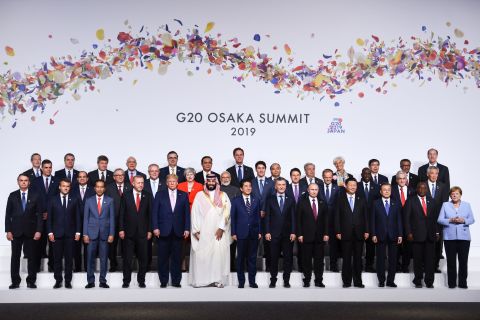
G20 official picture: the messages


Some people will spend a bit of their time reading the official picture of the 2019 G20 Meeting just held in Osaka. These types of pictures contain many hints. They cannot be taken lightly. The protocol and the political seniors of the host country – in this case, the Japanese who are masters in matters of meaning and symbology – invest a lot of working days deciding the positioning of everyone in the picture. Their final choice has a deep political import.

This year’s photo gives special attention to the Saudi Crown Prince Mohammed bin Salman. He stands at the centre, between the host, Prime Minister Shinto Abe, and the US President. We could think that such placing might be related to the fact that Abe is just back from a visit to Iran and he wanted to show that he also pays special attention to the diplomacy towards Saudi Arabia. Maybe he would love it to be interpreted that way. But it is just a happy coincidence for the Japanese. Abe is close to the Crown Prince because Saudi Arabia will be organising the next G20 Meeting, in November next year.

That’s the reason why the President of Argentina, Mauricio Macri, is also on the front row. The last meeting took place in his country (2018). That’s protocol.

Then, the rest of the front row brings together some of usual suspects: the leaders of China, Russia, Germany and France. But also, some special friends of Japan. First, two close neighbours, South Korea and Indonesia. And three other countries representing other regions of the world: Brazil, Turkey and South Africa. Surprising is to see Prime Minister Modi emerging in the second row. That’s not where India should be.

On the last row, a bit lost as he looks in the wrong direction, we can find the UN Secretary-General. This is not new. It has nothing to do with António Guterres. To place the UN boss in the background has been the tradition. I always thought such positioning sends a very inappropriate signal. The UN must be better recognised by the world leaders, particularly in a meeting that deals with global issues. It is important to battle for that.

In the end, my overall assessment of the meeting is positive. Many people might say these summits have no real purpose and are not useful. That’s a respectable way of looking at them. I want to take the opposite view, particularly in respect of this one. We are living in a period of tensions and great complexities. These leaders have the power to make it go in the right direction. They represent most of the world’s population and 85% of the global economy. When they meet and send some positive messages, the world feels a little bit more hopeful.