Showing posts with label G20. Show all posts

Monday, 11 September 2023

Commenting on the G20 Final Communiqué

 I share the frustration expressed by many regarding the outcome of the G20 just held.

The final statement reiterates many of the commitments made elsewhere. Particularly, in many United Nations meetings. As I said in the Portuguese media, the main issue is that promises are made but their implementation lacks far behind or never happens. That is the best way to undermine the leadership, be it at the county level or in the global arena. It explains why the credibility of the international leaders is so low.  

This said, it was important to bring back to the final communiqué all those points that are being discussed in the key international conferences. That includes the SDG, the climate discussions, the gender issues, the inequality problems, the respect for the UN Charter and for people’s rights. And the matters of peace and war. 


The point on the reform of the World Bank is also a wise play.  


Words and statement most be seen as significant, even when we know that human rights or any other key issues are not respected in the country whose leader has pledged to. It gives those who care and who fight for those rights a leverage point. Strength, I would say.


Regarding the African Union, I agree it is a crucial move. It is also a smart move for South Africa, that has now a reason to say no to Nigeria or Egypt in the G20.  


In the end, I think we should see India and others encouraging multilateral approaches and multilateralism but planning to play in small groupings and betting as much as possible in bilateral relations and pure and tough national interests.  

Sunday, 17 July 2022

G20: is it a better forum?

The G20 as a model for tomorrow's Security Council

Victor Ângelo


Today I am not writing about Ukraine, although I recognise that it is fundamental to keep the subject at the top of the public communication agenda. That is, by the way, one of the great risks of this crisis: the Putinists, their neo-Stalinist and neo-fascist relatives, not to mention the useful idiots who spout off in the media and cackle from their perches, would like to see the Russian invasion disappear from the headlines. In this day and age, what comes off the front page is easily ignored. These people think it is convenient to forget the aggression decided by Vladimir Putin, which, moreover, has nothing geopolitical about it - if it did, the autocrat would have a different position on the candidacies of Finland and Sweden for NATO membership, not to mention the Baltics. It is now clear that Putin is dreaming up the old wives' tale of the historical destiny of Mother Russia.

I will not discuss the subject of NATO this time either. That will be the subject of future chronicles. Even knowing what has been written around, including a full-page article in a well-known weekly newspaper - a flood that shows at least two flaws: that the author does not know how the NATO budget is constructed; and that he gives an importance to the Secretary-General of the organisation that he does not have. Jens Stoltenberg is a skilful facilitator, well presented, prudent with his words, a balancer who makes a virtue of his weak oratory skills. But the power does not belong to him. It resides in some member states, starting with the USA, but not only there. Take countries like Poland and Latvia, for example, and not forgetting the example of Turkey. To claim, without hesitation, that Stoltenberg is the boss of Europe, or the West, is the idle talk of someone who says a lot about something he knows little or nothing about.  

Someone suggested I write about the recent BRICS summit in Beijing on 23 June, this being the year of the Chinese presidency. It was clear that China is seeking to transform the BRICS into a political and economic bloc capable of being an alternative to the G7. And for this, it is trying to introduce a new format, which would include, besides Brazil, Russia, India, China and South Africa, other emerging countries, Argentina in Latin America, Egypt, Nigeria and Senegal in Africa, and others, such as Thailand, Indonesia or even Kazakhstan. Here I would make two observations, after recognising the economic dynamism of China and the relative weight of the other members in the world economy. First, the BRICS, like the G7, speak of cooperation and multilateralism, but in reality constitute blocs inspired by rivalry and hegemony. Second, if I had to choose between the democracy and human security practised in the BRICS or in the G7, I would certainly prefer the Japanese model, for example, to that of neighbouring China. The values of freedoms and human rights are fundamental criteria.

Indeed, my purpose is to underline the potential that exists at G20 level. This is the only organisation outside the United Nations system that can bring together the powerful North and South. It should therefore be seen as a good bet for international political and economic collaboration. And today it is essential to talk again about cooperation and complementarity, given the challenges we all face. Leaders must get out of merely antagonistic speeches.

The G20 foreign ministers have been meeting since yesterday in Bali, Indonesia. Despite the tense atmosphere, none have missed the call, not even Antony Blinken and Sergei Lavrov. No bilateral discussions are expected between the two. The hostility between Russia and the US is too great, unfortunately leaving no room for a meeting at that level. But Blinken met with his Chinese counterpart, Wang Yi, and was positive. He showed that the G20 offers opportunities, that it is a platform that should be maintained and strengthened. Its composition prefigures to some extent what would be a modern version of the UN Security Council.

(Automatic translation of the opinion piece I published in the Diário de Notícias, the old and prestigious Lisbon newspaper. Edition dated 8 July 2022)


Friday, 19 February 2021

The G20 should coordinate the global response

A vaccine against geopolitical rivalries

Victor Angelo


Boris Johnson convened an extraordinary virtual G7 summit today. He justified it by saying it was urgent to find an agreement that would allow a global response to covid-19, i.e. access for all to the immunisation possible. He added that it would also be an opportunity to coordinate demand for vaccines to avoid a headlong rush to the few quantities already available. The summit would be the occasion to resolve the competition between states, which, if it continues, could lead to serious political fractures between traditional partners, as seen recently in the increased tension between the EU and the London government.

The UK holds the G7 presidency in 2021. Hence the legitimacy of Johnson's initiative. But the prime minister may have other objectives well beyond seeking a global response to the pandemic. The man is a skilled politician with a knack for spectacular actions. He will try to make the most of the opportunity that the leadership of the G7 offers him to show his constituents that he has a global stature capable of setting the agenda of the group of the most developed countries. If this translates into an increase in international cooperation, which badly needs to be stimulated, we can only be grateful.

I fear, however, that it will not achieve that result. The subject of the meeting is clearly a priority, but it cannot be limited to the G7 countries. It is true that Australia, South Korea, and India have also been invited to take part in the summit. India counts in terms of vaccine production. But the invitation reflects, above all, the UK's specific interest in strengthening its relations with these countries and not the contribution they can make to getting vaccines to the poorest and most remote parts of the world. It also reflects another political agenda, one that is shared by others, especially Joe Biden. That of thwarting the geopolitical ambitions of the main rivals of the United States and its Western allies. But making international policy at the cost of a pandemic does not seem to me to be ethically acceptable.

In fact, it would be more appropriate to organise a G20 meeting to deal with the harmonisation of vaccine distribution and define everyone's contribution to achieving this objective. The G20 has the merit of sitting at the same table all the G7 countries plus China and Russia, among others. Coordination with these two States is fundamental for a rapid, effective, and generalised fight against the virus. The intrusion of hegemonic rivalries should not be admitted when it comes to responding to a problem that threatens the health of all, social progress, and the stability of the future. According to World Bank estimates, the pandemic has already pushed a dramatic number of people back into extreme poverty - it could be around 115 million. Moreover, the lack of access to vaccines for people in the poorest countries will cause a global distortion with unimaginable consequences. Among other things, international inequalities would become even more accentuated, even explosive. The worsening of imbalances between regions of the globe is one of the greatest risks facing us.

The G20 is currently chaired by Italy. The Italian executive, now with Mario Draghi at its head, faces immense internal problems. It is not in a position to play a leading role on the international stage at a time when the latter needs a giant to mobilise it in an undisputed way. Draghi is scheduled to hold a global summit in Rome on 21 May on the pandemic and related issues. May is, however, an eternity away when urgent decisions are needed.

In the meantime, in a positive spirit, I hope that today's G7 meeting will make it possible to strengthen COVAX, the mechanism set up by the WHO, in collaboration with various organisations, to guarantee countries with limited financial and operational resources equitable access to covid vaccines. If this happens, we will have to recognise that the initiative taken by Boris Johnson will have had some merit.


(Automatic translation of the opinion piece I published today in the Diário de Notícias, the old and prestigious Lisbon newspaper)


Tuesday, 14 April 2020

Time for exceptional leadership to step up


This is a time of great anxiety. It’s a global challenge. It would require global political leadership, men and women in decisive positions of authority that would come together and would address the crisis with a single voice. It is not enough to have the G7 or the G20 finance ministers talking about debt relief and access to tremendous amounts of theoretical money. It is also not enough to get statements from the IMF, the WB or the WHO. Even the UN Security Council, if it could agree on a resolution, that would be good but insufficient. We need the key heads of State and government to agree on a joint declaration that would be some guide of roadmap out of the crisis. It would send an exceptionally important message of togetherness, cooperation and hope.

Unfortunately, we are very far from such a common position. The world is leaderless and more fragmented than ever.

If we can’t have a global message, why don’t we try to agree on a common European position at the leadership level? Is it too difficult to formulate a joint way forward, that would be larger than just talking about the post-crisis recovery, something of a shared vision about the kind of European society we would like to build together, after such a unique test?

The moment calls for leadership that can unite people and envision tomorrow’s world.  

Saturday, 29 June 2019

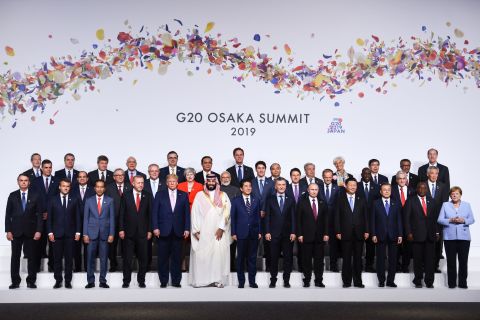
G20 official picture: the messages


Some people will spend a bit of their time reading the official picture of the 2019 G20 Meeting just held in Osaka. These types of pictures contain many hints. They cannot be taken lightly. The protocol and the political seniors of the host country – in this case, the Japanese who are masters in matters of meaning and symbology – invest a lot of working days deciding the positioning of everyone in the picture. Their final choice has a deep political import.

This year’s photo gives special attention to the Saudi Crown Prince Mohammed bin Salman. He stands at the centre, between the host, Prime Minister Shinto Abe, and the US President. We could think that such placing might be related to the fact that Abe is just back from a visit to Iran and he wanted to show that he also pays special attention to the diplomacy towards Saudi Arabia. Maybe he would love it to be interpreted that way. But it is just a happy coincidence for the Japanese. Abe is close to the Crown Prince because Saudi Arabia will be organising the next G20 Meeting, in November next year.

That’s the reason why the President of Argentina, Mauricio Macri, is also on the front row. The last meeting took place in his country (2018). That’s protocol.

Then, the rest of the front row brings together some of usual suspects: the leaders of China, Russia, Germany and France. But also, some special friends of Japan. First, two close neighbours, South Korea and Indonesia. And three other countries representing other regions of the world: Brazil, Turkey and South Africa. Surprising is to see Prime Minister Modi emerging in the second row. That’s not where India should be.

On the last row, a bit lost as he looks in the wrong direction, we can find the UN Secretary-General. This is not new. It has nothing to do with António Guterres. To place the UN boss in the background has been the tradition. I always thought such positioning sends a very inappropriate signal. The UN must be better recognised by the world leaders, particularly in a meeting that deals with global issues. It is important to battle for that.

In the end, my overall assessment of the meeting is positive. Many people might say these summits have no real purpose and are not useful. That’s a respectable way of looking at them. I want to take the opposite view, particularly in respect of this one. We are living in a period of tensions and great complexities. These leaders have the power to make it go in the right direction. They represent most of the world’s population and 85% of the global economy. When they meet and send some positive messages, the world feels a little bit more hopeful.


Wednesday, 12 July 2017

My reading of the G20 summit (2017)

On the recent G20, the negative issues on the table, either openly or coated in diplomatic words, could be summarised as follows:

- The risks linked to international uncontrolled massive migrations;
- The US withdrawal from the Paris accord on Climate Change
- New trends towards trade protectionism
- The attempts to side-line key international organisations, including the UN, the WTO and the Human Rights Council.

The positives, as I see them:

- Establishment of a new fund, to be administered by the WB, to promote the entrepreneurship of African women; USD 325 million.
- The review of steel overcapacity issue and the recommendation that a plan of action should be prepared by Nov. 2017 to address this most divisive economic and trade issue.
- More coordination on the fight against terrorism and violent extremism.
- The leaders have shown they want to find a common ground on a number of issues.


Thursday, 29 June 2017

Renewed confidence in Europe

The EU leaders participating in the forthcoming G20 Summit, scheduled for next week, met today in Germany to coordinate their views on key agenda issues.

This was a very positive initiative, a development that should be recognised.


It shows a fresh level of determination in matters of European policy coordination and harmonization. It was also a manifestation of the new momentum Europe is experiencing and that gives us a new breath of confidence in our shared future. 

Sunday, 4 September 2016

The G20 summit is appreciated

I am one of those who is convinced that meetings such as the G20 are important. It takes us nowhere to have a cynical view about these types of summits.

This year´s edition is about to begin in China. The leaders might have serious differences of opinion on key issues. There might be accrued tension between China and the West. And some opportunistic views against globalisation. But is wise to give the leaders a chance to meet on a regular basis. These platforms put pressure on them to reach compromises. And to take action together. All that contributes to a less tense international scene.

On the eve of tomorrow´s meeting, China and the US have decided to ratify the Paris agreement on Climate Change. That agreement is critical for our future. And we can only commend President Xi and President Obama for the move. They have sent a very strong signal and tremendously contribute to enhance the G20´s image.

The signal should now be picked by the Europeans. They must move very fast with their own ratification. There is no real reason for further delays. That will be good for the environment as well for their popularity at home.


Sunday, 16 November 2014

800 at the G20

I am told the G20 leaders have approved 800 new measures. And I answer I can´t believe it. It is not possible. Someone is making fun of us. 

Saturday, 15 November 2014

The heavy skies above the G20 Annual Summit


G20 annual summits have become a meaningless ritual. The one taking place today and tomorrow in the delightful city of Brisbane, Australia, is no exception. Just a few grandiose statements and a handful of leaders that are pretty preoccupied with their own home problems. The statements on global issues are just the usual staff, prepared by the aides and delivered for the gallery.

But this year´s meeting takes place at a time of great tensions. These tensions are now much bigger than the dramatic situations in the Middle East or in parts of Africa. To their complexities we should add new ones, in other corners of the world. These are dangerous times. One cannot ignore the seriousness of the dispute with Russia. And one should not ignore the potential for armed conflict in East Asia.

And these new realities were there in Brisbane and have made the atmosphere of the summit much heavier. Interestingly, Brisbane is used to heavy skies. So, its choice as the venue for the 2015 Summit of the G20 ended up by being rather symbolic. 

Thursday, 5 September 2013

A very complex environment around President Obama's choice

As we reach the end of today, we notice that the President Obama’s military option is losing momentum in the US House of Representatives and also in the American and European public opinions. It is become a tough call for the President.

In addition, Pope Francis's letter to the G20 leaders cannot be easily dismissed. The Pope reminds all of us that there is no alternative to the crisis but through dialogue and that a military intervention will make things much more difficult.


All this is creating an environment that will be deeply against the strikes once they take place. President Obama – and François  Hollande as well – will have to deal with the consequences in and around Syria, plus with the citizens’ views in their respective countries. This will transform  any military action into a political challenge of great complexity. It will open many unknown avenues.

Sunday, 1 September 2013

G20 and Syria

Syria continues to occupy the front pages. It will also be the key matter on the table at the G20 meeting this week in St. Petersburg on 5 and 6 September. It is not on the agenda but it will dominate the discussions. President Obama's decision to strike Syria will be the ghost in the room. The fact that he is delaying any action until the following week will give some space for diplomatic consultations. But it will certainly not change the positions of the key players, especially Russia.

In the meantime, one would expect that the UN Secretary-General be prepared by then to share the preliminary conclusions of the inspections with the Security Council members. That would add some substance to the G20 exchanges.