Showing posts with label Mohammed bin Salman. Show all posts

Friday, 31 January 2025

Deep Seek and Light Trump: the new globalism

 Artificial Intelligence, the competition between the great powers and Trump's disorientation

Victor Angelo


As in previous weeks, the week began with a big surprise, this time coming from China. It was the emergence of a new version in the field of Artificial Intelligence (AI), an efficient and incredibly cheap Chinese program, competing at the highest level with the very expensive solutions coming from the USA. It came up with the name DeepSeek and is ready to give an instant response in a variety of languages. The news, which in just a few hours caused American and European technology companies to lose hundreds of billions of dollars in the capital markets, brought with it two major messages.

The first is about money, showing that it is possible to successfully invest in AI without spending the fabulous sums that large North American multinationals have been spending. The Chinese experience seems to show that the capitalization of Western competitors is more related to stock speculation than to real financing needs. They are true incubators of billionaires. The value of shares listed on the NASDAQ in New York or on certain European stock exchanges has much more to do with capitalist greed than with the scientific and business costs of large technology corporations based in California and one or another European location.

This observation regarding costs brings to mind what comes to us from Ukraine: the country's armed forces are using AI on a large scale, transforming classic equipment into digitally operated weapons. They are thus able, with modest expenditure, to go far and strike hard, almost compensating for their lack of weapons when faced with a much more powerful aggressor, and thus obtain unbelievable results. For the avoidance of doubt, I will immediately add that Ukraine is doing what it can with domestic science, but it continues to urgently need massive assistance in terms of air defense, artillery, ammunition, missiles and aircraft, and much more material available in the Western countries, but delivered with a half-closed hand and a short and timid arm, so as not to irritate excessively the delinquent who lives in the Kremlin.

The second message we get from China is that the country is much more advanced in terms of AI than Americans and Europeans think. American supremacy shook a lot this week. We do not have concrete data on this subject, but we already know two things: on the one hand, that Beijing considers the issue a top priority; and that President Xi Jinping argues that whoever wins the digital race will be the strongest global power in the future. This is one of the reasons why he is betting on the forced annexation of Taiwan, a territory that has a cutting-edge industry in terms of the production of nanochips, which are essential for top AI performance. The other reason for Beijing's high interest in Taiwan stems from a mix of ultranationalism and imperial, geopolitical ambition. Xi is fortunate that President Donald Trump confused, as happened this week in one of his verbal slips, Taiwan as an extension of the People's Republic of China. The same Trump who also seems unaware that Taiwan has around 65 billion dollars invested in the US in the area of ​​cyber technologies.

And so we entered the second week of the Trump administration. In addition to the flood of measures he set in motion, the carriage's progress confirms what was already feared.

Domestically, his first executive orders are potentially disastrous for the country's economy and social stability. They will accentuate internal fractures and could provoke serious political unrest.

On the international scene, it can be predicted that we will see the collapse of the multilateral system. WHO appeared as a first target, for reasons of competition with China, and for no other reason. China could be, and most likely will be, the main beneficiary of the Trump Administration's fury against UN organizations. NATO itself could also be the target of this furor against the international system. It will not be destroyed by Trump's wrath, but it could face moments of great turbulence in the face of the impositions and contradictions invented in Washington.

Still on the subject of foreign policy, Trump will limit himself to dealing with Benjamin Netanyahu, Vladimir Putin, both wanted by international justice, with Xi Jinping and with the Crown Prince of Saudi Arabia, Mohammed bin Salman, an expert in the dismemberment of journalists. And perhaps also with the exotic, crazy and murderous Kim Jong-un. Netanyahu will be in Washington next week as the first official guest. As for Europe, Trump will want to see on the map not a European Union or valuable allies, but a scattering of countries that he thinks have already passed into history.

Sunday, 17 July 2022

Joe Biden and his Middle East mistake

Joe Biden, the Middle East and consistency in politics

Victor Angelo


After two days spent in Israel and Palestine, the American President is today in Jeddah, Saudi Arabia.  Even having read what Joe Biden wrote in the Washington Post on July 9, to try to justify his voyage, I am one of those who do not agree with the political opportunity of this trip. I see it as a move of mere opportunism.

In the present context of confrontation with Russia, the trip weakens those who use the arguments of respect for international law, democracy and human rights. The Middle East is a maze of problems with no solution in sight. A geopolitical labyrinth where, among others, the United States is also lost. In the region, in addition to the suffering in the countries visited and in occupied Palestine, we still have the inhuman violence of the Syrian regime, with a fratricidal war that has dragged on since 2011, the barbarity of the conflict in Yemen, the chaos in Lebanon, the Iranian threat, the oppression of the Kurdish populations, fundamentalist extremism and the deadly rivalries between Sunnis and Shiites. It is a question of dealing with a powder keg that explodes according to the interests of the different local or international players.

A visit that does not bring any kind of response to the Palestinian question, to the obscurantism and cruelty of the Saudi regime, or to the containment of the Iranian threat, can only be noted in the negative. Biden was in Israel with the November mid-term elections in his country in mind and to please a part of his domestic voter base. And he is in Saudi Arabia to seek to increase oil production in order to contain the price of a barrel. This is also an electoral concern: the cost of petrol, when it comes time to fill up the tank, is a strong political argument in the USA. But it will not be easy to convince the Saudis, who are already adding 400,000 barrels a day more compared to what they were doing in February. Note, moreover, that Saudi daily production is now equivalent to Russian, both occupying (almost ex aequo) second place in the world.

Israel is not comparable to Saudi Arabia. But the systematic violation of the rights of Palestinians is one of the strongest arguments used by those who accuse the US of using a double-edged sword in international relations. The Palestinian cause has for decades been one of the most important thorns in the throat of those who speak of the need to respect the international order and the rights of oppressed peoples. You can't fight for that in the case of Ukraine and turn a blind eye when it comes to the same in Palestine.

Saudi Arabia is a country of contradictions. Modern in technology, medieval in the rights of women, of poor immigrant workers or in the treatment of political opposition. The Crown Prince, Mohammed bin Salman, personifies well these contradictions and the brutality of the regime. He will go down in history for having had opposition journalist Jamal Khashoggi murdered and hacked to pieces in 2018. Joe Biden had said during his election campaign that this crime had turned Saudi Arabia into a pariah state. Today, he will shake hands with the ringleader of the killers and discuss cooperation and oil. The prince will look good in the photo, even more arrogant than usual. The American president, on the other hand, will be more vulnerable.

It is time to repeat that in international politics not everything counts. And to underline once again that believing in principles has a cost. The narrative has to become clearer. Political leadership will only be credible if it is coherent. Spending time thinking about the next elections, political manoeuvring and expedients that vary according to the interests at stake may lead to the re-election of presidents, prime ministers and secretaries-general, but it does not contribute to solving the major problems. The current crises, in the Middle East, Eastern Europe, Sri Lanka, Pakistan or Myanmar, in parts of Africa or Central America, as well as in the field of climate change, nature conservation or food insecurity and the fight against poverty, should teach us to be truthful, responsible and courageous. In these times of great problems, this way of doing politics is the greatest challenge.

(Automatic translation of the opinion piece I published in the Diário de Notícias, the old and prestigious Lisbon newspaper. Edition dated 15 July 2022)


Tuesday, 17 September 2019

To launch drones and other missiles is a serious mistake


I do not know yet who is behind the destructive action taken against the Saudi oil facilities on Saturday. I see many fingers pointing in the direction of Iran. They might be right. We will see. But what I certainly know is that the attacks must be considered acts of war and very serious political mistakes. Whoever took the decision to launch the drones and the missiles must be made to understand that conflict escalation can only bring further destruction and misery to the region. Our condemnation of such decision cannot be ambiguous. It must be as strong as they make them, which does not necessarily mean military retaliation. It means isolation and sanctions.  

Saturday, 29 June 2019

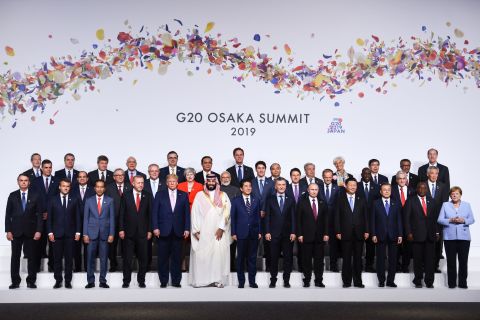
G20 official picture: the messages


Some people will spend a bit of their time reading the official picture of the 2019 G20 Meeting just held in Osaka. These types of pictures contain many hints. They cannot be taken lightly. The protocol and the political seniors of the host country – in this case, the Japanese who are masters in matters of meaning and symbology – invest a lot of working days deciding the positioning of everyone in the picture. Their final choice has a deep political import.

This year’s photo gives special attention to the Saudi Crown Prince Mohammed bin Salman. He stands at the centre, between the host, Prime Minister Shinto Abe, and the US President. We could think that such placing might be related to the fact that Abe is just back from a visit to Iran and he wanted to show that he also pays special attention to the diplomacy towards Saudi Arabia. Maybe he would love it to be interpreted that way. But it is just a happy coincidence for the Japanese. Abe is close to the Crown Prince because Saudi Arabia will be organising the next G20 Meeting, in November next year.

That’s the reason why the President of Argentina, Mauricio Macri, is also on the front row. The last meeting took place in his country (2018). That’s protocol.

Then, the rest of the front row brings together some of usual suspects: the leaders of China, Russia, Germany and France. But also, some special friends of Japan. First, two close neighbours, South Korea and Indonesia. And three other countries representing other regions of the world: Brazil, Turkey and South Africa. Surprising is to see Prime Minister Modi emerging in the second row. That’s not where India should be.

On the last row, a bit lost as he looks in the wrong direction, we can find the UN Secretary-General. This is not new. It has nothing to do with António Guterres. To place the UN boss in the background has been the tradition. I always thought such positioning sends a very inappropriate signal. The UN must be better recognised by the world leaders, particularly in a meeting that deals with global issues. It is important to battle for that.

In the end, my overall assessment of the meeting is positive. Many people might say these summits have no real purpose and are not useful. That’s a respectable way of looking at them. I want to take the opposite view, particularly in respect of this one. We are living in a period of tensions and great complexities. These leaders have the power to make it go in the right direction. They represent most of the world’s population and 85% of the global economy. When they meet and send some positive messages, the world feels a little bit more hopeful.


Thursday, 20 June 2019

Malaysia Airlines and Jamal Khashoggi


Yesterday, we got two pieces of news that reminded us that the respect for international norms is currently very low. States act as they please and just ignore the existing enforcement mechanisms that the international system has built during the past decades. Alliances of countries that share the same interests have become stronger than the UN, its principles and its regulatory instruments. The Security Council, established as the ultimate authority in terms of peace and security, is at present simply ineffective. That has a major impact on the UN’s image and work as well as on respect for multilateral answers to shared problems.

All this makes might rule over right. It is a field day for dictators and strong men. Above all, it is a serious regression and a dangerous state of affairs. One must express one’s fear and condemnation of States that do not respect the established international rules. One should not remain silent.

One of the news was about the Malaysia Airlines plane that was shot down in 2014 over Ukraine. Key people have now been accused of murder. More indictments are yet to be announced. We can lament that it took to long to come up with these four names. True. But it is a step in the right direction, a move that shows this type of state-sponsored crimes cannot be carried out without punishment. Blame and shame might not be enough. But it is important to do it, to point in the direction of the powerful, particularly when the chances of bringing the accused to justice are very slim.

The second one was about the cruel assassination of Jamal Khashoggi. The UN Special Rapporteur’s words were very clear about the Saudi Crown Prince’s responsibility. Basically, she said there is enough evidence to warrant a criminal investigation of his role. But Saudi Arabia and its main allies do not want to accept that at all. One should not be surprised by the Saudi position. However, one should state in very direct and unambiguous terms that we cannot accept the whitewash the Western countries are engaged in. Saudi Arabia must follow international law. And our role, the role of the democratic countries, is to advise Saudi Arabia to abide. But we are not doing it. And that is a serious breach of the international order that took decades to be shaped.


Saturday, 27 April 2019

Primitive Saudi Princes


The Saudi authorities have executed 37 citizens this week. They were accused of terrorism, as defined by the Saudis. The fact of the matter is that almost everyone was a Shia Muslim, a minority in Saudi Arabia that is not welcome and is seriously threatened by the regime that controls the country. And there is enough evidence that due process was not followed. Confessions were obtained under extreme torture and brought to the attention of the courts. The judges paid no attention to those claims. They just did what the Crown Prince and his clique wanted. And 37 people were beheaded in these times of today.

I really believe that the West must review its relations with some barbaric and deeply undemocratic countries. Saudi Arabia is one of them. There are more, including in the same vicinity. It is time for a different approach to diplomacy.