Showing posts with label Saudi Arabia. Show all posts

Sunday, 17 July 2022

Joe Biden and his Middle East mistake

Joe Biden, the Middle East and consistency in politics

Victor Angelo


After two days spent in Israel and Palestine, the American President is today in Jeddah, Saudi Arabia.  Even having read what Joe Biden wrote in the Washington Post on July 9, to try to justify his voyage, I am one of those who do not agree with the political opportunity of this trip. I see it as a move of mere opportunism.

In the present context of confrontation with Russia, the trip weakens those who use the arguments of respect for international law, democracy and human rights. The Middle East is a maze of problems with no solution in sight. A geopolitical labyrinth where, among others, the United States is also lost. In the region, in addition to the suffering in the countries visited and in occupied Palestine, we still have the inhuman violence of the Syrian regime, with a fratricidal war that has dragged on since 2011, the barbarity of the conflict in Yemen, the chaos in Lebanon, the Iranian threat, the oppression of the Kurdish populations, fundamentalist extremism and the deadly rivalries between Sunnis and Shiites. It is a question of dealing with a powder keg that explodes according to the interests of the different local or international players.

A visit that does not bring any kind of response to the Palestinian question, to the obscurantism and cruelty of the Saudi regime, or to the containment of the Iranian threat, can only be noted in the negative. Biden was in Israel with the November mid-term elections in his country in mind and to please a part of his domestic voter base. And he is in Saudi Arabia to seek to increase oil production in order to contain the price of a barrel. This is also an electoral concern: the cost of petrol, when it comes time to fill up the tank, is a strong political argument in the USA. But it will not be easy to convince the Saudis, who are already adding 400,000 barrels a day more compared to what they were doing in February. Note, moreover, that Saudi daily production is now equivalent to Russian, both occupying (almost ex aequo) second place in the world.

Israel is not comparable to Saudi Arabia. But the systematic violation of the rights of Palestinians is one of the strongest arguments used by those who accuse the US of using a double-edged sword in international relations. The Palestinian cause has for decades been one of the most important thorns in the throat of those who speak of the need to respect the international order and the rights of oppressed peoples. You can't fight for that in the case of Ukraine and turn a blind eye when it comes to the same in Palestine.

Saudi Arabia is a country of contradictions. Modern in technology, medieval in the rights of women, of poor immigrant workers or in the treatment of political opposition. The Crown Prince, Mohammed bin Salman, personifies well these contradictions and the brutality of the regime. He will go down in history for having had opposition journalist Jamal Khashoggi murdered and hacked to pieces in 2018. Joe Biden had said during his election campaign that this crime had turned Saudi Arabia into a pariah state. Today, he will shake hands with the ringleader of the killers and discuss cooperation and oil. The prince will look good in the photo, even more arrogant than usual. The American president, on the other hand, will be more vulnerable.

It is time to repeat that in international politics not everything counts. And to underline once again that believing in principles has a cost. The narrative has to become clearer. Political leadership will only be credible if it is coherent. Spending time thinking about the next elections, political manoeuvring and expedients that vary according to the interests at stake may lead to the re-election of presidents, prime ministers and secretaries-general, but it does not contribute to solving the major problems. The current crises, in the Middle East, Eastern Europe, Sri Lanka, Pakistan or Myanmar, in parts of Africa or Central America, as well as in the field of climate change, nature conservation or food insecurity and the fight against poverty, should teach us to be truthful, responsible and courageous. In these times of great problems, this way of doing politics is the greatest challenge.

(Automatic translation of the opinion piece I published in the Diário de Notícias, the old and prestigious Lisbon newspaper. Edition dated 15 July 2022)


Sunday, 6 December 2020

Writing about Iran

Iran: the next day

Victor Angelo


In 2018, Mohsen Fakhrizadeh became known when Benjamin Netanyahu accused him of being the scientist at the head of the Iranian nuclear programme. Fakhrizadeh was murdered on the outskirts of Tehran a week ago. There are contradictory accounts of the crime. What is certain is that the ambush was conducted by a reasonable number of agents, at least ten of them, and in a professional way - the wife, who was travelling with him, came out of it unharmed, she was not part of the objective. I have no doubt that the ambush was carried out by special forces, with perfectly trained executioners, who had at their disposal the information, logistics and means necessary for a high-risk mission. It is peaceful to conclude that it was not the work of the internal Iranian opposition. It had all the characteristics of an operation planned, organised, and carried out by a state hostile to Iran. And I cannot help but think of the regime's three main enemies: Saudi Arabia, Israel, and Donald Trump's United States.

Those who know these things point in the direction of Israel. It is true that the secret services of that country, in particular the legendary Mossad, have already demonstrated an incomparably greater ability to penetrate Iranian official circles than any other espionage service. One example of this ability, with the trial of the indicted currently taking place in Antwerp, is the following: it was Mossad that made known to the Belgian authorities the terrorist attack the Iranian government was plotting in 2018 against the National Council of Iranian Resistance in exile. The European intelligence services where the plot was being prepared - the Belgians, the French, and the Austrians - had not noticed anything. 

Israel can never admit the slightest hint of responsibility for murders of this kind. Such an admission would open the door to prosecution in the International Court of Justice in The Hague or in the jurisdiction of a United Nations member country. International law is clear. An extraterritorial, summary, and arbitrary execution, promoted by a State outside a situation of armed conflict is a crime which violates international human rights law, the 1949 Geneva Conventions and the 1977 Additional Protocols. Moreover, the United Nations Charter expressly prohibits the extraterritorial use of force in times of peace.

For all these reasons, the paternity of what has now happened to Fakhrizadeh will remain unknown for the time being. We will have to be contented with the suspicions.

The assassination has shown that the Iranian system of internal espionage and counterespionage, which terrifies the population, has very serious flaws. The powerful Ministry of Intelligence is more concerned with the repression of the growing internal opposition than it is prepared to identify the most sophisticated threats from outside. This is not new. In early July, for example, the security services were unable to prevent an explosion at the Natanz nuclear power plant, nor were they able to avert the sabotage of missile-making programmes. All these actions were handled by a foreign country.  

A fundamental issue is to try to understand the central motive for the assassination. What seems more obvious, which would be to strike a major blow capable of further delaying the regime's nuclear programme, makes no sense. The country already has several teams of scientists capable of enriching uranium. The attack on Natanz and the sabotage have already delayed the plans. The real reason must be different.

If we look upstream, we will see that the Israeli government is on the brink of collapse and that Netanyahu will need convincing campaign arguments again. The presumption of a strong hand against the ayatollahs will certainly bring a good number of votes. Looking further ahead, we see that the new Biden administration is in favour of reopening a negotiating process with Tehran. This would be more difficult if the clerics responded to what happened to Fakhrizadeh in a violent manner. The old leaders of Iran are fanatical and backward. But they are astute in international politics. They must look at the assassination as an attempt at political provocation. And they know that waiting patiently for Joe Biden to take office may be the best response to the challenge they were given days ago.

(Automatic translation of the opinion piece I published today in the Diário de Notícias, the old and prestigious Lisbon newspaper)


Saturday, 12 September 2020

On Mali and the region


In today’s Diário de Notícias (Lisbon)

Notes on Mali

Victor Angelo


Mali is a fascinating country, diverse in its landscapes and cultures. It is home to great singers and traditional musicians who play the korah, an ancestral instrument made from a large gourd, the Dogon masks and statues, birthplace of the city of Timbuktu, a unique historical reference in Islamic studies. For four centuries, until 1670, Mali was the epicentre of a great empire in West Africa, an empire recognized by Portuguese explorers, who traded extensively with it across the Gambia River. I would also add that I had several Malian colleagues at the UN who proved to be excellent professionals and held important positions in the different multilateral organizations. I write this to fight the summary opinions of those who are in the habit of arranging everything African in a dark corner, in the shadow of the usual prejudices. I am sad, like many others, when I see the country tearing itself apart and becoming insecure, as it continues to do daily.

Mali has made the news again in the last three weeks following the military coup of August 18. It is, for the same reason, the subject of debate, including in European circles. Moreover, some conspiracy theorists have seen Moscow's hand behind the colonels who took power, a hypothesis I consider unlikely. But there are other hands at work in Mali, from France to Saudi Arabia, and with vastly different intentions.

Also, at stake is the role of the United Nations, which has maintained a peace mission in the country since 2013, with more than 15,000 elements. MINUSMA, as the mission is called, has, over time, become a case study because it has not been able to respond to the political and governance issues that are at the heart of Mali's problems. The political direction of the mission resolved, to please the French and out of strategic opportunism, to stick to the president that the coup has now deposed. In New York, at the Security Council, no one had the courage to correct this trajectory. Thus, credibility is lost, and the future is mortgaged. 

Returning to the current debate, it should have emphasized that more than two thirds of Mali's population is under 25 years of age. And that education and the economy are unable to meet the challenges that such an age pyramid entails. When I was in Mali for the first time in 1990, its total population was around eight and a half million. Today, thirty years later, it is close to twenty million. The same happens in the other countries of the region. They all have explosive age pyramids. Demographic pressure has grown throughout the Sahel along with the advance of desertification and poverty. Being young in the Sahel means looking to the future and seeing only a multitude of arid politics, a desert of opportunities and a chaotic and inhumane urban habitat. Thus, hope and social peace are hard to achieve. All that remains is migration to Europe, or else adherence to armed banditry and fanatical rebellions. Fanaticism has grown exponentially over the past decade, thanks in particular to the proliferation of mosques, Wahabist koranic schools and radical preachers, all financed by the Saudis and others of the kind. 

Those who neither emigrate nor join the extremist groups, vegetate in the big cities, where they can observe how social inequalities have become blatant, the fruit of the corruption that prevails in political circles, in the security forces and in the administration of justice. They also see that European countries and other international actors turn a blind eye to the manipulations practiced by the powerful. This is what happened in Mali. After months of popular protest against the indifference of the president and the greed of his own circle of friends, a group of senior officials decided to act. They have popular support, at least for now. It is true that one should not support anti-constitutional coups. But it is also true that one can no longer pretend that one does not see corruption, ineptitude and the failure of territorial administration, with vast areas of national space without any state presence. The mitigation of crises begins with the promotion of probity and the restoration of local power, beyond the treatment of youth issues. This is what we must remind the colonels, the leaders of the region, the UN Security Council and the European partners of Mali, Portugal included. 


Sunday, 5 July 2020

Iran's growing dependence on China


Iran is counting on China’s investments and political support. China will become the most powerful ally of Iran. Oil is one of the reasons, but not the only one. They are now negotiating a cooperation framework for the next 25 years. All in all, Iran will become seriously dependent on China.

As the Americans invest in their relationship with the Saudis, the Chinese can only get interested on the opposing side. Saudi Arabia and Iran are fierce rivals in the region. A good deal of the future of the Middle East will derive from such rivalry. But behind it, there is the growing and dangerous competition between the US and China.

Saturday, 4 January 2020

The EU's position on Iranian matters


As I express my disagreement and concern regarding the decision to execute General Qassem Soleimani, I must also recognise that the regime he spent his life fighting for is an aberration in today’s world.

I acknowledge the rights of the Iranian people to decide about their government and its politics. The problem is that their leaders do not give the people the freedom to choose. The leaders have imposed on the population a religion-based dictatorship, that has all the features of a medieval type of life. The country has become hell on earth, in the name of God. That is unacceptable, in Iran, as well as in the neighbouring countries or anywhere else in the world. And that must be denounced in all kinds of forums. The condemnation is not about religion, it is about making use of religious beliefs to impose a totalitarian regime on people.  

The European approach to such countries must combine pressure on human rights and democratic values with economic restrictions. In addition, it must include serious security measures to avoid those countries’ hostile actions, including the promotion they could make of all kinds of radicalism and religious fanaticism. Our policy must be a delicate mix of firmness, encouragement, dialogue, distance and prudence. In the end, it is about sticks and carrots, but certainly not about drones and bombs. It should also be about helping other countries that want to move away from the influence of those theocratic dictatorships.

This approach is certainly very different from the one President Trump is pursuing. That’s our right and nobody in Washington can challenge it. Secretary Pompeo’s remarks about the role of EU countries – he basically said that key European States have not been supportive enough of the American action – are not welcome. Here, as in other occasions, it is our duty to be clear about our policies towards a very explosive and complex area of the globe. And our policies are not subordinated to the views in Washington, or elsewhere outside the EU.


Monday, 30 December 2019

Iran and its allies at sea


What a present, just before the end of the year! Irony apart, the joint naval exercise that has just taken place in the Gulf of Oman and brought together Iran, Russia and China aimed at sending a very powerful message to the US and its allies. And it did.

The Oman sea lane is especially important for China’s strategic interests. It is, in my opinion, a top priority among China’s lines of communication with the world. That’s why they decided to participate. They wanted to demonstrate their navy’s modernity and outreach. For Russia, it was an opportunity to show they are back as an international maritime power. Both countries wanted also to send a message about stability in the region, meaning, their political commitment to discourage any strike against Iran, because it could have extraordinary consequences for a large part of the Middle East.

And in the case of Iran, the message was clear: to show they have powerful allies. Therefore, they should be left alone.

We must also note this exercise was a new one. It had not happened in the past.


Sunday, 22 September 2019

Iran is choosing the wrong approach


The drone cum missile attacks against Saudi oil facilities remain a major international issue. Analysts have tried to read beyond these strikes. They seek to understand what Iran’s game plan is. That’s certainly a key question, in addition to several others. We need a plausible answer to it.

Iran is clearly coordinating its actions with their clients in Yemen, the Houthi rebels. Today, both Iran and the Houthi leadership have extended a hand of dialogue. Last week, the hand they were showing resulted in the attacks, a clear act of war. Now, they talk about bringing down the tension. At the same time, the Iranians organise military parades and public demonstrations of force.

But, again, the question is what is their plan? Escalation, on one side, and diplomatic talk, on the other, is a tactic but not a strategy. It is actually a very dangerous approach. It can easily get things out of hand. And that risk is still very much in the air. We are not out of the danger zone.

Iranian leaders think they are now in a stronger position. That’s probably the reason for the attacks. They wanted to show they can strike a country as heavily armed as Saudi Arabia is. A country that is a close ally of the Americans. They wanted to be seen as a sophisticated military power. And send a message that it is better to negotiate with them than to confront them. The problem is that they have little support outside the small circle that is constituted by a few client governments and a couple of armed groups. Bigger countries will choose the Saudi side, if they have to. And the extensive sanctions the US has imposed on them will ruin their fragile economy and will create further opposition to the clerics that control Iran’s power machinery.

I can only anticipate disaster for Iran, if they continue to strike the neighbours and to make bellicose announcements. Therefore, I see the attacks against the Saudi refineries and plants as a very serious miscalculation. It is a tactical victory and a strategic error.


Tuesday, 17 September 2019

To launch drones and other missiles is a serious mistake


I do not know yet who is behind the destructive action taken against the Saudi oil facilities on Saturday. I see many fingers pointing in the direction of Iran. They might be right. We will see. But what I certainly know is that the attacks must be considered acts of war and very serious political mistakes. Whoever took the decision to launch the drones and the missiles must be made to understand that conflict escalation can only bring further destruction and misery to the region. Our condemnation of such decision cannot be ambiguous. It must be as strong as they make them, which does not necessarily mean military retaliation. It means isolation and sanctions.  

Monday, 16 September 2019

Our reaction to the drone attacks


The drone attacks against the Saudi oil refineries brought a new level of danger and complication to the complex conflict involving, among others, Yemen, Iran and, of course, Saudi Arabia as well as an external actor such as the United States. 

The reactions we have seen in the key markets go beyond the oil supply issue. They indicate there is a deep concern about the crisis in that part of Middle East and its geopolitical consequences. 

I can understand the fears. Anything can happen. However, as long as there is a tiny hope of a summit between the US President and the Iranian one, I think we can expect our side to hesitate and avoid extreme actions. Am I right? I hope so. The opposite would take us into a much deeper conflict of unimaginable proportions.

Sunday, 21 July 2019

Hormuz: to avert further deterioration


As we start the last week of July, we must be profoundly aware that the situation around the Strait of Hormuz represents an extraordinary menace for peace and security in the region. In addition, if it escalates further it will have a serious impact on the economy of major international players, well beyond the region. Most of the oil the Gulf countries export – close to 85% of it – goes to major Asian economies, to China, India, Japan, Singapore and South Korea.

We need to see a major initiative launched with the objective of de-escalating the confrontation. It should come from the UN, if at all possible. If not, it could be initiated by the Prime Minister of India, Narendra Modi. His country has high stakes at play and, at the same time, has a voice that matters in the region and the UK.


Saturday, 29 June 2019

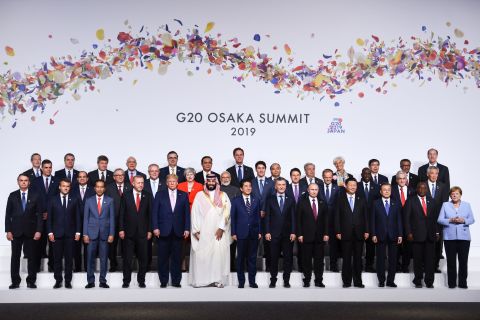
G20 official picture: the messages


Some people will spend a bit of their time reading the official picture of the 2019 G20 Meeting just held in Osaka. These types of pictures contain many hints. They cannot be taken lightly. The protocol and the political seniors of the host country – in this case, the Japanese who are masters in matters of meaning and symbology – invest a lot of working days deciding the positioning of everyone in the picture. Their final choice has a deep political import.

This year’s photo gives special attention to the Saudi Crown Prince Mohammed bin Salman. He stands at the centre, between the host, Prime Minister Shinto Abe, and the US President. We could think that such placing might be related to the fact that Abe is just back from a visit to Iran and he wanted to show that he also pays special attention to the diplomacy towards Saudi Arabia. Maybe he would love it to be interpreted that way. But it is just a happy coincidence for the Japanese. Abe is close to the Crown Prince because Saudi Arabia will be organising the next G20 Meeting, in November next year.

That’s the reason why the President of Argentina, Mauricio Macri, is also on the front row. The last meeting took place in his country (2018). That’s protocol.

Then, the rest of the front row brings together some of usual suspects: the leaders of China, Russia, Germany and France. But also, some special friends of Japan. First, two close neighbours, South Korea and Indonesia. And three other countries representing other regions of the world: Brazil, Turkey and South Africa. Surprising is to see Prime Minister Modi emerging in the second row. That’s not where India should be.

On the last row, a bit lost as he looks in the wrong direction, we can find the UN Secretary-General. This is not new. It has nothing to do with António Guterres. To place the UN boss in the background has been the tradition. I always thought such positioning sends a very inappropriate signal. The UN must be better recognised by the world leaders, particularly in a meeting that deals with global issues. It is important to battle for that.

In the end, my overall assessment of the meeting is positive. Many people might say these summits have no real purpose and are not useful. That’s a respectable way of looking at them. I want to take the opposite view, particularly in respect of this one. We are living in a period of tensions and great complexities. These leaders have the power to make it go in the right direction. They represent most of the world’s population and 85% of the global economy. When they meet and send some positive messages, the world feels a little bit more hopeful.


Saturday, 22 June 2019

Iran, West Africa and the info war game


We are witnessing the emergence of a new campaign against Iran that includes “information” about that country’s growing presence in West Africa, the Sahel and Sudan. It basically says that, following data available to certain security agencies – not named –, Iran is engaged in building a network of terrorist cells in those regions of Africa. Those cells would later be activated against Western interests in the countries concerned.

I have known these corners of Africa for decades. And I have several friends in positions of authority in the area, including in matters of internal security. There is indeed a serious increase of radical activities and armed groups over there. But their link with Iran seems very unlikely. Certainly, very difficult to prove. Those radicals are inspired by Sunni fundamentalism, whilst Iran is a Shiite proponent of Islam.

What I have noticed, and my friends have confirmed, is that the new radicalism in that belt of Africa is mainly supported by groups and mosques based in Saudi Arabia, the Gulf States, especially in Qatar, as well as in Pakistan. In addition, there is also some influence coming from Egypt.

Thursday, 20 June 2019

Malaysia Airlines and Jamal Khashoggi


Yesterday, we got two pieces of news that reminded us that the respect for international norms is currently very low. States act as they please and just ignore the existing enforcement mechanisms that the international system has built during the past decades. Alliances of countries that share the same interests have become stronger than the UN, its principles and its regulatory instruments. The Security Council, established as the ultimate authority in terms of peace and security, is at present simply ineffective. That has a major impact on the UN’s image and work as well as on respect for multilateral answers to shared problems.

All this makes might rule over right. It is a field day for dictators and strong men. Above all, it is a serious regression and a dangerous state of affairs. One must express one’s fear and condemnation of States that do not respect the established international rules. One should not remain silent.

One of the news was about the Malaysia Airlines plane that was shot down in 2014 over Ukraine. Key people have now been accused of murder. More indictments are yet to be announced. We can lament that it took to long to come up with these four names. True. But it is a step in the right direction, a move that shows this type of state-sponsored crimes cannot be carried out without punishment. Blame and shame might not be enough. But it is important to do it, to point in the direction of the powerful, particularly when the chances of bringing the accused to justice are very slim.

The second one was about the cruel assassination of Jamal Khashoggi. The UN Special Rapporteur’s words were very clear about the Saudi Crown Prince’s responsibility. Basically, she said there is enough evidence to warrant a criminal investigation of his role. But Saudi Arabia and its main allies do not want to accept that at all. One should not be surprised by the Saudi position. However, one should state in very direct and unambiguous terms that we cannot accept the whitewash the Western countries are engaged in. Saudi Arabia must follow international law. And our role, the role of the democratic countries, is to advise Saudi Arabia to abide. But we are not doing it. And that is a serious breach of the international order that took decades to be shaped.


Saturday, 15 June 2019

Sudan, the people and the Western interests


Not too long ago, during my time in the Sahel Region, I met regularly with Sudanese community villagers, men and women, as well as with officials. I had also to deal with the security and humanitarian consequences of the Janjaweed militias, the armed groups doing the dirty work in Darfur at the service of Omar al-Bashir. I gained then a lot of admiration for the people of Sudan and felt deeply their aspiration for security and democracy. I also learned how strategic the Khartoum leadership could be, including the intelligence agencies and the generals.

The fall of al-Bashir, following the continued, widespread popular pressure, came to me as good news. But I also knew that the military and security establishment, including the militias, now operating as Rapid Support Forces (RSF), would not let it go too easily. And that is the situation today. More than a hundred people were killed last week in the capital by the military and the militias, many more were wounded or raped. The establishment cannot lose control. They have a heavy hand on the economy – on what remains of it, as most of the economy is in a state of collapse – and they are also afraid to be brought to justice due to past crimes they have been associated with. Therefore, it is the survival of the al-Bashir regime’s elite that is now at stake. They are ready to make al-Bashir and a few others pay the bill. But they do not want it to go beyond that.

The generals, including General Mohamed Hamdan Dagalo, the RSF boss, are closely supported by the Saudis, the Egyptian President and the Military, and the United Arab Emirates leadership. The generals have sent Sudanese armed men to fight the Saudi-UAE war in Yemen, among other things. This is a smart alliance. It protects the Khartoum generals from pressure from the European Union and the US. For the West, the friends of our friends deserve some consideration, no doubt. That explains the relative lack of attention the Sudanese situation has generated in Brussels and other capitals. People’s rights are a beautiful thing as long as they do not interfere with Western interests in the region.

The Chinese have also strong stakes in Sudan, particularly related to the oil pipeline that crosses the country.

All this makes the Sudanese transition to democracy extremely challenging for the people of that great country.

Friday, 14 June 2019

Hormuz tensions


Yesterday’s attacks on two petrochemical tankers sailing in the vicinity of the Strait of Hormuz should ring strident alarm bells. They make obvious there is a strong player that is betting on escalating the tensions in the region. And the fact of the matter is that we do not know who is playing such a destructive card.

We can try to guess based on a careful analysis of some nations’ strategic interests. However, at this stage to point the finger in one direction only contributes to augment the tension. It is certainly not the wisest approach. It should not be accepted.

The UN Secretary-General, António Guterres, should step forward and offer the organisation’s good offices to carry out an independent investigation of the incidents. The International Maritime Organisation could be part of it. In the meantime, he should dispatch a Special Envoy to the region. For instance, the UN Under-Secretary-General for Political and Peacebuilding Affairs. That move would help to lessen the regional political temperature.

Monday, 13 May 2019

Iran and the EU approach


Today, unexpectedly, Secretary of State Mike Pompeo came to Brussels. He met the Foreign Ministers of France, Germany and the UK, and briefly, the EU High Representative for Foreign Policy. The matter was Iran.

The US Administration has placed Iran at the top of its international agenda, next to two other critical themes: the trade talks with China and the internal situation in Venezuela. The American leadership is clearly betting on isolating Iran as a way of weakening the regime. Such policy is above all inspired by advice coming from Israel and Saudi Arabia. Both countries want Iran down.

This is certainly a very risky policy.

The alleged sabotage of four oil tankers in the very sensitive area around the Strait of Hormuz, which was big headlines today, is another very serious development in a very explosive environment. It is unclear what really happened to the ships and who was behind the actions, whatever actions they could have been. To draw any conclusion without more information would be extremely foolish. If there was indeed a big issue with those tankers, if an attack took place, an international commission on enquiry should be mandated to assess the facts. I hope the Europeans told something like that to Pompeo. I expressed interest in being part of the investigation.

I understand there was little common ground today between the visiting Secretary and the EU Ministers. That’s is encouraging. The Europeans must show they have their own way of looking at Iran and the Middle East, for that matter. They appreciate the alliance with the US but, at the same time, they must assert their independent views. Particularly when the gravity of the situation does not allow any misguided approach. As it does not tolerate a partisan policy, choosing the Saudi or the Israel side when the region needs a cool and balanced line to be followed by the Europeans.


Saturday, 27 April 2019

Primitive Saudi Princes


The Saudi authorities have executed 37 citizens this week. They were accused of terrorism, as defined by the Saudis. The fact of the matter is that almost everyone was a Shia Muslim, a minority in Saudi Arabia that is not welcome and is seriously threatened by the regime that controls the country. And there is enough evidence that due process was not followed. Confessions were obtained under extreme torture and brought to the attention of the courts. The judges paid no attention to those claims. They just did what the Crown Prince and his clique wanted. And 37 people were beheaded in these times of today.

I really believe that the West must review its relations with some barbaric and deeply undemocratic countries. Saudi Arabia is one of them. There are more, including in the same vicinity. It is time for a different approach to diplomacy.

Saturday, 10 December 2016

Jammeh must go

Following Yahya Jammeh´s tragic volte-face, who has now changed his views on last week´s presidential elections and declared he will not accept the results, the UN Security Council met today to discuss the explosive situation The Gambia is now confronted with. The meeting was called at the request of Senegal, a country that surrounds The Gambia and has a very similar ethnic mix.

The Council has decided that Jammeh has no other option but to acknowledge the legitimacy of the election and move aside, for the winner to be sworn in with no undue delay.

This is not going to be easy to implement. Jammeh does not seem prepared to be reasonable. He is afraid of retribution and legal accusations, if he moves out of the State House.

In the circumstances, he should be offered political asylum elsewhere outside The Gambia. That should be the line of negotiations. It would facilitate the transition to democracy.


Where could he find asylum? That´s for the leaders of the region to decide and negotiate with the receiving state and Jammeh. But there are some countries that could be approached. For instance, Morocco and Saudi Arabia. 

Tuesday, 3 May 2016

There is no Syrian ownership of the peace talks

The Syrian Geneva process is clearly owned and directed by foreigners: the US, Russia, Saudi Arabia and somehow the UN, through its Special Envoy. The Syrian side – the many parties to the conflict – are sitting in the margins or squarely outside, far out. They are not committed to the process, one should add. And if that is the case I do not see how such an exercise can achieve any meaningful and durable results.  

Sunday, 28 February 2016

Saudi Arabia´s military muscle

Yesterday Saudi Arabia launched the military exercise called Northern Thunder. Most of us, in the West, did not notice it. As we did not realise that military contingents from around twenty states are participating in this major deployment. Among them, there are several African States – Chad, Morocco, Mauritania, Senegal, Sudan, Tunisia are some of them – as well as Asian countries, including Pakistan and Malaysia. Many of these soldiers had to be brought to Saudi Arabia at a very high cost. It is not cheap to deploy troops. I am sure Saudi Arabia has contributed quite a bit to make the voyages possible.

Beyond the military training, I see a strong political message. And I think it is important to keep that in mind.