Showing posts with label UN. Show all posts

Friday, 26 September 2025

AI comment of my opinion text about the UN General Assembly.

 https://www.dn.pt/opiniao/o-pessimismo-sobre-a-onu-%C3%A9-um-erro

The original version in Portuguese language of my op-ed of today 26/09/2025 in Diário de Notícias. 

The following text is an AI comment of my text.

Overall Rating: 4.5 out of 5

This is a well-structured and insightful piece of political commentary. The author effectively uses specific examples from the UN General Assembly to support a broader argument about the relevance and future of the United Nations. The writing is clear, the analysis is balanced, and the conclusion offers a nuanced perspective that avoids simplistic pessimism.


Detailed Analysis

Clarity and Structure (5/5)

The text is exceptionally clear and easy to follow. The author begins with a specific event—the speeches at the UN General Assembly—and uses it as a launching pad to discuss larger themes. The structure is logical:

  1. Introduction: Sets the scene at the UN General Assembly.

  2. Lula's Speech: Analyzes the positive and negative aspects of the Brazilian president's address, presenting him as a voice of the "Global South."

  3. Trump's Speech: Provides a stark contrast, portraying his speech as self-centered and detrimental to international cooperation.

  4. Macron and UN Reform: Introduces the crucial topic of UN reform, particularly the Security Council, and highlights the challenges.

  5. Conclusion: Synthesizes the arguments to argue against "pessimism about the UN," asserting its continued necessity despite its flaws.

Argument and Content (4.5/5)

The central argument—that pessimism about the UN is a mistake—is well-supported. The author acknowledges the organization's significant weaknesses, especially the paralysis of the Security Council due to the veto power of permanent members. However, they counter this by highlighting the continued importance of the UN's broader functions in addressing global issues like poverty, climate change, and human rights.

  • Strengths:

    • Balanced View: The text avoids a purely idealistic or cynical take on the UN. It recognizes both its failures (e.g., the Security Council's inaction) and its indispensable roles (e.g., addressing global problems).

    • Specific Examples: The analysis of Lula's and Trump's speeches provides concrete evidence to illustrate different approaches to multilateralism. The reference to Macron's proposal for Security Council reform adds a layer of specific policy discussion.

    • Strong Conclusion: The final paragraph effectively reinforces the main thesis, emphasizing that the existence of global problems necessitates a global body like the UN, and therefore, leaders should not give up on it.

  • Areas for Improvement (Minor):

    • The assertion that Trump's speech "should be viewed as a grave fault" is a strong opinion, but the author provides good reasoning for it. Some readers might find the characterization of Trump's speech as being "about Trump" to be a bit simplistic, even if a key point. However, within the context of the piece's purpose, it serves to highlight a contrast in leadership styles.

Language and Style (4.5/5)

The language is professional yet accessible. The author uses clear, direct prose without unnecessary jargon. The tone is authoritative and analytical.

  • Strengths:

    • Effective Use of Contrasts: The comparison between Lula and Trump is a powerful rhetorical device that clarifies the author's points about multilateralism versus isolationism.

    • Engaging Opening: The detail about Lula's speech being "one of the most striking" immediately draws the reader in.

    • Concise Summaries: Phrases like "Trump spoke about Trump" or describing Lula's speech as a "firm voice representing the Global South" are effective and memorable.

  • Areas for Improvement (Minor):

    • Some phrasing, like "pecha grave" (grave fault) to describe Lula's stance on Ukraine, is a bit informal for a serious political analysis, but it's a minor stylistic point.

In conclusion, this text is a high-quality piece of political commentary. It's well-reasoned, clearly articulated, and makes a compelling case against a common form of political fatalism regarding the United Nations. It successfully uses a recent event to spark a deeper, more meaningful discussion about global governance.

Friday, 19 September 2025

My full text of today about the UN General Assembly translated by AI


The UN and its General Assembly Must Be Taken Seriously

Victor Ângelo

The annual high-level session of the UN General Assembly begins next week. The leaders of most of the states that make up the international scene will be in New York. One of the exceptions will be the President of the Palestinian Authority, Mahmoud Abbas. The American administration has not granted him or his delegation an entry visa. It can refuse to grant a visa, and has done so in the past on rare occasions, despite the Headquarters Agreement signed by Washington in 1947. This agreement stipulates the general, but not absolute, obligation to grant visas to representatives of states intending to participate in UN meetings, especially in the case of the General Assembly.

As always, the US justified the decision by invoking national security and foreign policy reasons. The real motives are clear. First, it is about showing the total alignment of American leadership with the government of Israel. Second, it is to express displeasure with the initiative by Emmanuel Macron and other leaders to bring to the General Assembly the proposal for the recognition of Palestine as a full UN member state. And finally, it is to punish the Palestinians for having filed several complaints against Israel in the international courts based in The Hague.

In any case, the Assembly will vote on Palestine, as proposed by France, the United Kingdom, Spain, Canada, Saudi Arabia, and other members. The UN currently has 147 countries that recognize Palestine as a state. This number is expected to increase significantly after the vote. Israel will be diplomatically more isolated if it is confirmed that its policy on Palestine is not accepted by almost all states, with the exception of the U.S. and a few others.

The vote will have a symbolic, non-binding political value. No state can become a full member of the United Nations with only the favorable vote of the General Assembly. It inevitably needs the support of the Security Council, with no veto from the five permanent members. In this case, it is evident that the U.S. will exercise its veto. Trump will ignore the will of the community of nations. And he will remind us that the right to veto is a historical aberration that needs to be reviewed, or at a minimum, deeply restricted given the new balance of power in the international framework.

Trump's speech on the morning of the first day (23/09) is awaited with enormous apprehension. It begins with an originality: for the first time, an American president speaks at the podium without the process of appointing a permanent U.S. representative having been completed. In May, the White House announced that Mike Waltz would be the representative of the Trump Administration to the UN, after having played the very important role of National Security Advisor and then being dismissed a few weeks later. His confirmation is still dragging on in the Senate corridors. The U.S. is represented in New York by a team of interims, who receive few or no directives from Washington. Trump does not have the UN on his list of priorities, except when it comes to leaving certain organizations or cutting or eliminating the financial contributions he is obligated to pay to the UN system.

He will certainly insist on a UN fundamentally focused on peace and international security, words spoken for reasons of mere personal image. Trump dreams of being seen as the mediator par excellence of conflicts, the champion of peace, worthy of the Nobel Prize. He does not believe in the UN's capacity in this matter. In reality, I believe he places no value on the United Nations. It is just a podium that allows him to display his oversized ego. But he does not want an active UN in any of the system's three pillars: international stability, development, and human rights.

The responsibility for stability, which should stem from respect for the UN Charter and international law, falls to the Americans, according to his way of thinking. Development, social progress, and environmental issues are matters for the Europeans. He forgets, however, that in these areas, the ones gaining ground are the Chinese, who are deeply committed to an alternative political and economic order, in a broad alliance with the so-called Global South. As for human rights, the issue will be left to the domain of the use of force and to the interpretations that each state will make of the dignity and life of its citizens. For the Chinese and their allies, human rights are a matter of national sovereignty that should not be included in the multilateral agenda.

All of this signifies the marginalization of the UN's political and human dimensions. Next week will allow us to better understand what the future of the UN may be.

Meanwhile, António Guterres launched what he called an exercise in system reform in May. He named it UN80 and said it would have three objectives: reduce expenses; eliminate mandates that no longer make sense; and carry out an institutional transformation. It was an ambitious plan that could only be successful if it had the support of the major countries and was carried out in dialogue with the organization's staff. None of that happened. In reality, the priority should have been to go door-to-door and beg the delinquent states, such as the U.S. and China, to honor their financial commitments. UN reform begins with holding each member state accountable.

Friday, 5 February 2021

From Myanmar to the EU: a quick journey

Suu Kyi and our Ursula

Victor Angelo


I intended to write about the coup d'état in Myanmar. I follow regularly what happens there, especially the role of civil society associations in defending citizens, the Chinese investments, and their political impact, as well as the actions carried out by the different ethnic-based armed groups. China, which is the second largest foreign investor in the country - the first is Singapore - shares a long border with Myanmar and sees its neighbour mainly as an economic corridor with shorter and more direct access to the Gulf of Bengal. This corridor is of huge strategic interest to the Chinese, both for gas and oil imports and for exports to the Middle East and Africa. The messages I would include in my text would be to condemn the military coup and defend the process of democratisation that began in 2015 and the November 2020 legislative elections – which the Carter Center considered acceptable despite the restrictions imposed by the pandemic and the armed rebellions.

I would also seek to discuss the question marks that Aung San Suu Kyi's political activity has raised in Western circles, while recalling that she won the November elections by a large majority. The appreciation of the Burmese is very different from the judgments that we, with our European eyes, make. I would have mentioned in my text the impasse that exists in the UN Security Council when it comes to take decisions about that country. This inability to condemn has been clearly demonstrated since 2017 when close to a million Rohingya people were persecuted and expelled to neighbouring Bangladesh. The objection always comes from the same side, from Beijing, and with Moscow doing the political favour of aligning itself with the Chinese, in a tactical manoeuvre to obtain Chinese political dividends. This time, however, I was surprised by the positive. China and the other members of the Security Council yesterday approved a declaration which I consider strong and which explicitly condemns the military coup and the arbitrary arrest of Aung San Suu Kyi and all the others. It was an encouraging surprise, including a clear call for respect for human rights and freedoms, including those of the press. I would speculate that this agreement on Myanmar is a good sign, which could be seen as a conciliatory gesture by Xi Jinping addressed to Joe Biden. 

However, I have decided to change my mind and focus on the mess that the vaccination campaign in the European Union has become. Each day shows that the issue of vaccines is highly political, and that delays, failures, slowdowns and injustices can have a devastating effect on the image of the European Commission and the moral authority and stability of national governments. It is also clear that the priority in the EU must be to immunise without delay the largest number of citizens.

At the end of December, Ursula von der Leyen said, with a mixture of joy and arrogance, that the campaign was being launched simultaneously across Europe. The Commission rightly decided that orders with pharmacy industry would be placed in a unified way, for the whole EU. This would increase our negotiating strength in the face of a sector which is immensely powerful and experienced in writing commercial contracts. After five weeks, we have about 2.9% of the population vaccinated in the Union, and over 14.5% on Boris Johnson's land. The vaccines ordered are not made available to national health services because there is not enough production capacity, logistics and because the pharmaceuticals already had other contracts signed in advance.

Thus, we enter February with the clear realization that there is no more explosive subject than this. And with the certainty that it is fundamental to transform vaccination into a real campaign, urgent, massive, effective and with fair criteria accepted by the people. Otherwise, we would be heading for political and social chaos. Far and different from Myanmar, of course, but equally destabilising. 


(Automatic translation of the opinion piece I published today in the Diário de Notícias, the old and prestigious Lisbon newspaper)


Saturday, 12 September 2020

On Mali and the region


In today’s Diário de Notícias (Lisbon)

Notes on Mali

Victor Angelo


Mali is a fascinating country, diverse in its landscapes and cultures. It is home to great singers and traditional musicians who play the korah, an ancestral instrument made from a large gourd, the Dogon masks and statues, birthplace of the city of Timbuktu, a unique historical reference in Islamic studies. For four centuries, until 1670, Mali was the epicentre of a great empire in West Africa, an empire recognized by Portuguese explorers, who traded extensively with it across the Gambia River. I would also add that I had several Malian colleagues at the UN who proved to be excellent professionals and held important positions in the different multilateral organizations. I write this to fight the summary opinions of those who are in the habit of arranging everything African in a dark corner, in the shadow of the usual prejudices. I am sad, like many others, when I see the country tearing itself apart and becoming insecure, as it continues to do daily.

Mali has made the news again in the last three weeks following the military coup of August 18. It is, for the same reason, the subject of debate, including in European circles. Moreover, some conspiracy theorists have seen Moscow's hand behind the colonels who took power, a hypothesis I consider unlikely. But there are other hands at work in Mali, from France to Saudi Arabia, and with vastly different intentions.

Also, at stake is the role of the United Nations, which has maintained a peace mission in the country since 2013, with more than 15,000 elements. MINUSMA, as the mission is called, has, over time, become a case study because it has not been able to respond to the political and governance issues that are at the heart of Mali's problems. The political direction of the mission resolved, to please the French and out of strategic opportunism, to stick to the president that the coup has now deposed. In New York, at the Security Council, no one had the courage to correct this trajectory. Thus, credibility is lost, and the future is mortgaged. 

Returning to the current debate, it should have emphasized that more than two thirds of Mali's population is under 25 years of age. And that education and the economy are unable to meet the challenges that such an age pyramid entails. When I was in Mali for the first time in 1990, its total population was around eight and a half million. Today, thirty years later, it is close to twenty million. The same happens in the other countries of the region. They all have explosive age pyramids. Demographic pressure has grown throughout the Sahel along with the advance of desertification and poverty. Being young in the Sahel means looking to the future and seeing only a multitude of arid politics, a desert of opportunities and a chaotic and inhumane urban habitat. Thus, hope and social peace are hard to achieve. All that remains is migration to Europe, or else adherence to armed banditry and fanatical rebellions. Fanaticism has grown exponentially over the past decade, thanks in particular to the proliferation of mosques, Wahabist koranic schools and radical preachers, all financed by the Saudis and others of the kind. 

Those who neither emigrate nor join the extremist groups, vegetate in the big cities, where they can observe how social inequalities have become blatant, the fruit of the corruption that prevails in political circles, in the security forces and in the administration of justice. They also see that European countries and other international actors turn a blind eye to the manipulations practiced by the powerful. This is what happened in Mali. After months of popular protest against the indifference of the president and the greed of his own circle of friends, a group of senior officials decided to act. They have popular support, at least for now. It is true that one should not support anti-constitutional coups. But it is also true that one can no longer pretend that one does not see corruption, ineptitude and the failure of territorial administration, with vast areas of national space without any state presence. The mitigation of crises begins with the promotion of probity and the restoration of local power, beyond the treatment of youth issues. This is what we must remind the colonels, the leaders of the region, the UN Security Council and the European partners of Mali, Portugal included. 


Tuesday, 18 August 2020

Mali and its blind partners

 The serious political situation Mali is going through raises in my mind some fundamental questions about the political performance of the key external partners of the country. Basically, what I mean is that we cannot keep supporting national leaderships that are not appreciated by the vast majority of their people. We might feel comfortable with them. But what is the value of that if they are not accepted by their own citizens?

In this case, France, other European countries, and the UN have been supporting a regime that has not implemented the peace agreement they have signed with their own rebels and that has closed their eyes in an attempt not to see the rapid deterioration of the security and poverty situations. The partners played the same game.

And now, several years down the line, we have a much graver national crisis, that has grown into a regional one as well. And we see that the image of the external actors has also been seriously damaged. That is a sure way of undermining the role of the UN and of some key Western countries.


Friday, 27 March 2020

The required leadership is lacking


When the challenge is huge and its evolution unpredictable, the best approach is to concentrate all the efforts on containment. You limit the fire as much as possible. That means reducing the impact of the challenge and look for ways and means of controlling it. It also implies we mobilise everyone that can be called upon. The issue concerns everyone and each person can play a role in addressing it. That must be the message the leaders should bring forward. The collective effort. It’s a phase by phase combat but it is also part of a broader plan to resolve it. That must be said and repeated until every citizen gets to understand what is at play and the direction the leaders are taking.

This time the challenge is unique, profound and global. It requires a good combination of local actions and international cooperation. It concerns all nations. As such, we must put a much stronger emphasis on a concerted response. That emphasis and that type of action are still missing. Those who have the authority to call for that must act now. They have to move beyond their current timidity. Hesitation is not acceptable.

Thursday, 5 March 2020

Javier Pérez de Cuéllar: an exceptional diplomat


I know there are many things going on and competing for today’s headlines. All of them are of great importance. They concern people at the Turkish-Greek border, people in Idlib, Syria, people sick with the Covid-19 pandemic, people losing their jobs because of the pandemic’s tremendous economic impact, young people kept out of their classrooms, and so on. They also concern big political games, such as the Putin-Erdogan meeting, the US elections, the Japanese and the fate of this year’s Olympic Games, or the political crisis in Kabul. But my headline is about the passing away of Javier Pérez de Cuéllar, the former UN Secretary-General. He was an old-style diplomat but a very effective one. During his time at the head of the UN the organization managed to resolve a number of major conflicts and wars. He led an organization that achieved results and was the glue the Security Council needed to be able to function. Respected by everyone, he has shown that charisma is not about being loud and highly visible. Charisma is about persistence, coherence and principles. That summarizes the Secretary-General he was.


Saturday, 11 January 2020

Angela Merkel meets Vladimir Putin: good move


From a European perspective, the resolution of the Libyan civil conflict is a priority. Such crisis has several consequences that are of special importance for the EU Member States. It’s next door, it’s related to a very central migratory flow line, and it has also a serious impact on security in the larger Sahelian region.

But the conflict is far from being resolved. It is getting more complex and deeply dramatic these days. In such context, today’s travel to Moscow to meet President Putin has placed German Chancellor Angela Merkel at the centre of the European efforts. It was the right thing to do. The Europeans must talk to the Russians if they want to see the Libyan drama resolved. The Russians have been very supportive of one of the Libyan sides, the one led by the rebel General Khalifa Haftar. But they have not closed the door on the other side, the one based in Tripoli and recognised by the international community. Moreover, the Russians keep talking to other external actors that are involved in Libya’s domestic situation, to the Turks, the Egyptians and some Arab Gulf States.

Another positive move, out of today’s travel, is the reaffirmation by Angela Merkel that the Libyan peace process must be facilitated by the UN. This is the kind of support that is so much needed.  


Friday, 10 January 2020

Where is the UN Security Council?


These are very strange times. The international scene has been deeply challenged since the beginning of the New Year. And we heard no mention of the UN Security Council. The Council is supposed to be the ultimate custodian of international peace and security, I like to remember the people I talk to. Now, the Council seems to have become the ultimate guarantor of a silent approach to major crises. That should not be accepted.

Saturday, 28 September 2019

Pakistan, India and Kashmir


In January 1957, the Indian Permanent Representative to the UN, V. K. Krishna Menon, spoke for 8 hours, when addressing the Security Council on the situation in Kashmir. That speech remains the longest ever delivered at the UN. It was cut short, if I can say so, because Menon collapsed of exhaustion.

Compared to such feat, yesterday´s 50-minute speech by Pakistan’s Prime Minister was a brief episode. But a striking one, not because of its length – at the UN, it is considered a long speech that goes beyond 35 minutes; this year’s trend has been to have shorter interventions – but because of the words he said. He basically focused on the dispute with India regarding Kashmir. And he talked about the possibility of war between the two countries and made a direct reference to the use of nuclear weapons. Imran Khan stated that Pakistan would go for a nuclear response if there is war and his country is losing it against India.

Such assertion is most upsetting. There is indeed a serious state of cold confrontation between Pakistan and India. The Kashmir situation and Modi’s decision to cancel the autonomy of the region have brought the complexity of conflict to the fore. We have there an extremely dangerous threat to international peace and security. Khan’s words have confirmed it.

Pakistan is getting closer and closer to China. Its dramatic economic situation makes Pakistan very dependent on China’s investments and economic cooperation. China, on the other hand, sees India as a growing competitor. But I can’t believe the Chinese would encourage Pakistan to go for an armed conflict with India. They cannot imagine that such clash would reduce India’s capacity to compete. 

In my opinion, the Chinese should be encouraged to mediate in between both countries. That would have an impact on the easing of the tensions and would strengthen the international standing of China. With the accord of the two antagonistic nations, the Chinese could also bring the matter to the Security Council, to get a greater buy-in for a peaceful way forward.

It is not easy, though. The Indian Prime Minister sees the Kashmir crisis as an internal challenge, a domestic affair. He does not welcome any type of international assistance on the issue. 

That was fine until yesterday, I would retort. With Imran Khan’s dramatic speech at the UN, the issue cannot be anything else but an international matter of great concern. It must be dealt as such and with great urgency. 


Saturday, 29 June 2019

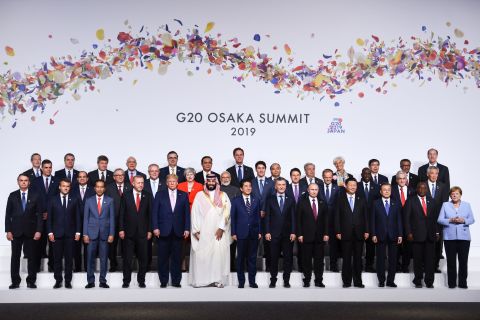
G20 official picture: the messages


Some people will spend a bit of their time reading the official picture of the 2019 G20 Meeting just held in Osaka. These types of pictures contain many hints. They cannot be taken lightly. The protocol and the political seniors of the host country – in this case, the Japanese who are masters in matters of meaning and symbology – invest a lot of working days deciding the positioning of everyone in the picture. Their final choice has a deep political import.

This year’s photo gives special attention to the Saudi Crown Prince Mohammed bin Salman. He stands at the centre, between the host, Prime Minister Shinto Abe, and the US President. We could think that such placing might be related to the fact that Abe is just back from a visit to Iran and he wanted to show that he also pays special attention to the diplomacy towards Saudi Arabia. Maybe he would love it to be interpreted that way. But it is just a happy coincidence for the Japanese. Abe is close to the Crown Prince because Saudi Arabia will be organising the next G20 Meeting, in November next year.

That’s the reason why the President of Argentina, Mauricio Macri, is also on the front row. The last meeting took place in his country (2018). That’s protocol.

Then, the rest of the front row brings together some of usual suspects: the leaders of China, Russia, Germany and France. But also, some special friends of Japan. First, two close neighbours, South Korea and Indonesia. And three other countries representing other regions of the world: Brazil, Turkey and South Africa. Surprising is to see Prime Minister Modi emerging in the second row. That’s not where India should be.

On the last row, a bit lost as he looks in the wrong direction, we can find the UN Secretary-General. This is not new. It has nothing to do with António Guterres. To place the UN boss in the background has been the tradition. I always thought such positioning sends a very inappropriate signal. The UN must be better recognised by the world leaders, particularly in a meeting that deals with global issues. It is important to battle for that.

In the end, my overall assessment of the meeting is positive. Many people might say these summits have no real purpose and are not useful. That’s a respectable way of looking at them. I want to take the opposite view, particularly in respect of this one. We are living in a period of tensions and great complexities. These leaders have the power to make it go in the right direction. They represent most of the world’s population and 85% of the global economy. When they meet and send some positive messages, the world feels a little bit more hopeful.


Wednesday, 26 June 2019

The UN and the current crises


The United Nations is always required to be politically smart. That’s the way I saw it, when performing the responsibilities that had been assigned to me. And that’s what I still believe to be the best approach. Smart means above all to be able to say what must be said but with the words that build trust and show concern. Timidity is not the best road to achieve results and guaranty the necessary credibility.

I mention it because today I had to state that things must get better. If the UN remains basically inspired by risk aversion, it will keep pushing itself to the margins of the key current issues.

The Member States must be reminded, as often as the opportunity arises and as it is authorised by the UN Charter and by the history of the organisation, that they ought to support the central role the UN is supposed to play in case of international crises and conflicts. They should also be helped to keep in mind – and act accordingly – that any conflict resolution situation and peacebuilding effort require a comprehensive response. The UN System has the know-how to provide comprehensiveness. And the System must say it loud and clear. It should also smartly – diplomatically – challenge those leaders who keep betting on a security solution to complex crises. A security response, even a powerful one, is just a tool. It is not the master key.

Wednesday, 6 February 2019

Venezuela needs a credible mediation process


There are a few crisis situations in the world that must be seen as requiring urgent attention. Venezuela is certainly one of them. And, in terms of response, mediation is the word. It is necessary to find a mediation mechanism that could be accepted by both sides, meaning the Maduro camp and the Guaidó supporters.

Nicolás Maduro has asked the Pope to lead such mediation. It is true that the Catholic Church could play a facilitating role. But the other side has not expressed the same kind of appeal. Basically, they believe that Maduro´s presidency is not legitimate and, therefore, he must go without any concession being made. That position should be helped to evolve as rapidly as possible.

The United Nations could also be approached. Yet, I think Maduro sees the UN as too close to the Western interests. In the circumstances, the UN Secretary-General should take the initiative and be in personal contact with both leaders. The UN has a lot of experienced people in the field of mediation. And it could also work closely with the Vatican and offer a join platform for negotiations. Countries in the EU should send a message about the UN’s potential.

It’s equally critical that Maduro understands that there is a way forward for him and his family. The other side must leave a gate open for a dignified solution. It’s a mistake to try to push Maduro and his camp against the wall. That would make any bridging effort fail and it could easily bring mass violence instead a negotiated solution.

The mediation agenda would be defined by the parties. That’s how it should be. But I can guess it would certainly include issues such as the shape of the political transition, who would chair it, the organization of credible elections, the role of the armed forces and the police, as well as amnesty matters.

Monday, 23 April 2018

Syria: looking ahead


Regarding the Syrian complex crisis, it´s obvious that Assad and Putin believe in the military solution. And they are now close to achieve the military control of a good deal of the territory.
That option might result for a while, but it cannot resolve the deep divisions existing in the country. It does not address the overwhelming call for inclusiveness and democracy coming from so many segments of the population. It only suspends and postpones the crisis.

I am not sure Bashar al-Assad realises he must open up and engage in political dialogue, after winning on the military front. This should be the key message the EU leaders should put across to him. For that, they have no alternative but to re-engage the contacts with the strongman in Damascus. The channels of communication between the EU and Syria ought to be re-established.

That´s my advice as the EU prepares to chair another conference on Syria.

Such conference must not be just about humanitarian assistance coupled with a mere statement reiterating past options. Options that time has shown to be as good as dead ends.

Moreover, it is not a great idea to link in the same conference two different matters: humanitarian needs should be discussed in a different forum. Not good to mix them with politics.


Tuesday, 17 April 2018

Bringing the bullies together


When I scrutinise the foreign policies of permanent members of the UN Security Council I find no real differences, when it comes to the pursuit of their national interests. Each one of the five States is ready and willing to make use of force and go beyond the diplomatic conventions, tread into illegality, when its leaders think that the country´s national interests are at play. That´s particularly true for each country´s area of influence and strategic importance. It´s the case with China in the South China Sea, with Russia in Eastern Ukraine and Crimea, the US in Syria and Iran, the UK in West Africa and the Gulf Cooperation countries in the Persian shores, and with France in the Sahel Region of Africa.

The strategic options of these powerful countries take the primacy over the workings of the UN or other international organisations. It´s a fact, as well, that some of them do it more often than others. But when necessary, they will go for it. Norms and international law are to be respected as long as they do not collide with the views, ambitions and vital interests of the big five.

The primary role of the UN Secretary-General and other international voices, as well as the leaders of some key States such as India or Japan or South Africa, is to constantly recall the international norms and obligations. But it is also to look for points of equilibrium among the interests of the permanent members. Their critical geopolitical interests are known. The challenge is to negotiate taking them into account.


Saturday, 1 July 2017

The EU and the US

When it comes to the difficult response to the current US Administration, the EU leaders have decided to follow two lines.

First, to keep the political dialogue open. This policy dialogue should be centred on the key issues, particularly on respect for the international institutions, defence, trade and climate change. It should be based on clarity: the EU's positions should be stated without any unnecessary ambiguity.
Second, to emphasise the long term nature of the mutual relationship. Both sides have a long history of cooperation and share a number of fundamental values. That should be the basis to identify the common interests and to work together to achieve them. 

The suggestion made by some in Europe that today´s US leadership should be, as much as possible, ignored was not adopted. The EU political masters believe that a reasonable level of engagement should be cultivated.


Saturday, 8 April 2017

The reform of the UN Security Council

Acts of war and drawn-out conflicts are among the key factors that undermine the authority of UN Security Council. Actually, they have a major negative impact on the Council. And they are in open contradiction with the positions stated by some key members of the UN that keep repeating that it is important to improve the functioning of the Council and abide by its decisions.

This reminds me that the reform of the Security Council is not just about revisiting the issue of its membership. That one is already an impossible goal. However, it seems easier to achieve than the issues related to improving the Council’s capacity to resolve conflicts that are directly related to the strategic interests of its permanent members. Or the Council's approach to long lasting impasses. What could be the accepted doctrine on intervening in that type of intractable conflicts?


Thursday, 6 April 2017

Trump´s most pressing international challenges

This week, President Trump has been directly trapped by Bashar al-Assad of Syria and Kim Jong-un of North Korea. Both dictators decided to challenge the incoherence that defines the global policy of the new US President. Assad with sarin, the gas that he dropped from his airplanes and killed scores of innocent people. A true war crime, by all measures. Kim by firing a new missile towards the Sea of Japan, just a few days prior to his powerful neighbour´s visit to Florida for a first meeting with the big man from Washington.

He is also being challenged by Vladimir Putin. This special, unique strongman created the most absurd “explanation” to excuse the war crime committed by his ally in Syria. And decided to continue to block any action the UN Security Council could have taken on this appalling crisis.
The US President cannot limit his response to these major challenges to words of condemnation and expressions of outrage. They are essential, indeed, but not enough at this stage. He came to the White House as man of action and determination. He has now to show his resolution. Actions ought to match the promises.

But he has very narrow options.

The first one is about prioritising. He has to focus on one of his challengers and show that man that Trump means business. And that priority as things stand now should be about Assad. It must combine diplomatic initiatives, including a serious push for an international commission of inquiry, with other political measures and direct military pressure. The package has to be multifaceted, clear in its purpose, well explained to everyone but also limited in its range, in its initial stage. 

Saturday, 18 March 2017

UN funds should not be cut

The new US Administration plans to cut in a big way the country´s financial contributions to the UN. This decision, if it materialises, will have a major impact on programmes and operations at a time of greater demands and some extreme dramatic situations. 

At this early stage, it is not possible to measure the effect of such a decision. 

It´s only possible to say that the UN has the experience, the logistics and the credibility that make such operations tremendously cost-effective and able to reach many difficult corners of the globe. This might be a weak argument in some circles in Washington. But it is a strong reason for many to keep fighting for a strong, efficient, and properly funded UN system. 

Monday, 6 March 2017

Time for some tough questions about North Korea

Kim Jong-un, the North Korean dictator, is a crazy man. But above all, as a political leader, he is tremendously dangerous. For his people and for the region. He controls an all-pervasive internal security apparatus, a machinery that makes everyone in country look either as mentally retarded or simply terrified. In addition, the tyrant spends most of the country´s limited resources on military hardware, including on expensive nuclear research projects for aggressive ends, and on an incredibly large number of troops, that make North Korea the most militarised country in the world. All this represents a major threat to peace in the region and gives rise to an arms race that includes Japan and South Korea.

The UN Security Council has approved a series of sanctions against the North Korean regime. But the man keeps provoking the international community. Today, it was the launch of four ballistic missiles into the Sea of Japan.

It is now time to make the sanctions more stringent. They should also be expanded. One area could be related to the international travel of the North Korean officials. Those movements should be made more difficult. And the 47 countries housing North Korean embassies should be advised to limit the privileges of the country´s diplomats.


North Korea must understand they have a choice. One option is to accept the existing international order and behave as a partner country. The other, is to continue the rogue policies of today and then face as much isolation and constraints as the international community can implement. And if such rigorous approach by the international community does not bring a change, then it is time to ask some tougher questions about the way we should treat a regime of such nature.