The 2020 UN General Assembly has started. Unfortunately, due to the pandemic, the world leaders will not be travelling to New York for the General Debate, scheduled for next week. The debate will be even less participatory than in the past. They will be sending pre-recorded videos with their statements. But the most important dimension of the General Assembly, the side meetings between leaders, will be missing. Personal contact is critical in world affairs. Its absence makes all of us more fragile. It makes cooperation less pressing. At a time when we need augmented cooperation between the nations. These are indeed difficult times.
Showing posts with label world affairs. Show all posts
Showing posts with label world affairs. Show all posts
Tuesday, 15 September 2020


Thursday, 25 June 2020
We must be able to convince
The
cooperation between nations has been seriously impacted by the current crisis.
Each country decided the best way to battle the pandemic was to close the
borders and focus on the its domestic issues. Such an approach can somehow work
if the country is wealthy with a modern, extensive, and diversified economy. Australia
is a good example. Even Norway, at a much smaller case, can also be mention as
an example. But every country, rich or poor, depends on international trade,
investments, or development aid. These three areas have lost speed. They will
take quite a bit of time to recover. But above all, we must insist that today’s
and tomorrow’s world can only address the issues of recovery, peace and
security, climate change, and poverty, if countries cooperate and see
themselves as part of a community of nations with a common destiny. The United
Nations System and all the regional arrangements must regain their credibility.
The challenge in this case is to be able to lead the narrative about a better
world. It must be a convincing one, based on a constructive and balanced
approach. Most of the visions that are being shared are not seen as balanced. They
create a lot of fear in the minds and hearts of those who control economic
power and the information networks. That is the reason why they do not get to
the front pages. It is time to be a bit smarter when talking about the world we
all need to put in place.
Saturday, 9 May 2020
CNN is only about US disasters
I
have stopped watching CNN International for a while. The news is every day and
every hour about President Trump and the virus. Tiring. These are two very disturbing
subjects. Dangerous. An overdose of any of them can make you extremely sick. The
combination of both is explosive. I feel sorry for my American friends that
have to go through such a sorry moment. Nobody would expect the US to be confronted
with such a complex situation.
Tuesday, 6 August 2019
The dangerous game between the US and China
The
ongoing conflict between the US and China is reaching new levels of danger. It
would be a mistake to see it as just a trade dispute. This is about rivalry on
all fronts. The US President and his circle have a clear objective: make sure
China does not become a menacing strategic challenger. Their strategy is based
on two premises. First, if they manage to slow down the economic power of China
that will have an impact on the country’s internal stability, making it more
difficult for the Chinese to be a major world power. Second, they are convinced
that the Beijing leaders will blink first and yield to the American interests.
In the famous game of chicken President Trump seems to be playing, the one who gives
up first loses.
In
my opinion, both American premises have shaky foundations. China is on course
to be a be a global power and they will keep that ambition on a steady road.
The economic growth is strong enough – over 6% per annum – to ensure it will
happen. They will be able to fully challenge any other country, including the
US, by 2030, at the latest. Secondly, the game of chicken is always a disaster.
It will certainly be a disaster if the other player is China. Its leaders
cannot yield to the Americans. They will play with prudence, but the end game,
on their side, is to respond to confrontation with their own type of
confrontations. That is disaster in the making. That is the reason we should
not take the current crisis lightly. And that is why I think we need a third-party
mediation as soon as possible. The only problem is that I can’t see any actor
or institution being able to play such role.
Saturday, 29 June 2019
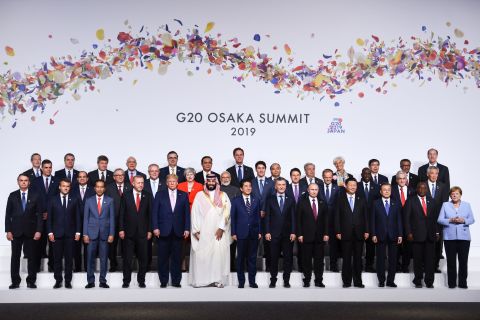
G20 official picture: the messages
Some
people will spend a bit of their time reading the official picture of the 2019
G20 Meeting just held in Osaka. These types of pictures contain many hints.
They cannot be taken lightly. The protocol and the political seniors of the
host country – in this case, the Japanese who are masters in matters of meaning
and symbology – invest a lot of working days deciding the positioning of
everyone in the picture. Their final choice has a deep political import.
This
year’s photo gives special attention to the Saudi Crown Prince Mohammed bin
Salman. He stands at the centre, between the host, Prime Minister Shinto Abe,
and the US President. We could think that such placing might be related to the
fact that Abe is just back from a visit to Iran and he wanted to show that he
also pays special attention to the diplomacy towards Saudi Arabia. Maybe he
would love it to be interpreted that way. But it is just a happy coincidence
for the Japanese. Abe is close to the Crown Prince because Saudi Arabia will be
organising the next G20 Meeting, in November next year.
That’s
the reason why the President of Argentina, Mauricio Macri, is also on the front
row. The last meeting took place in his country (2018). That’s protocol.
Then,
the rest of the front row brings together some of usual suspects: the leaders of
China, Russia, Germany and France. But also, some special friends of Japan.
First, two close neighbours, South Korea and Indonesia. And three other
countries representing other regions of the world: Brazil, Turkey and South
Africa. Surprising is to see Prime Minister Modi emerging in the second row.
That’s not where India should be.
On
the last row, a bit lost as he looks in the wrong direction, we can find the UN
Secretary-General. This is not new. It has nothing to do with António Guterres.
To place the UN boss in the background has been the tradition. I always thought
such positioning sends a very inappropriate signal. The UN must be better
recognised by the world leaders, particularly in a meeting that deals with
global issues. It is important to battle for that.
In
the end, my overall assessment of the meeting is positive. Many people might
say these summits have no real purpose and are not useful. That’s a respectable
way of looking at them. I want to take the opposite view, particularly in
respect of this one. We are living in a period of tensions and great
complexities. These leaders have the power to make it go in the right
direction. They represent most of the world’s population and 85% of the global
economy. When they meet and send some positive messages, the world feels a
little bit more hopeful.
Sunday, 31 March 2019
China and the waters
Global geostrategic
changes go very fast these days, thanks to the Chinese leadership.
Look
at this, for instance.
Back
in 2010 – just yesterday, one could say – the Chinese corporations had invested
in about 10 of the 50 largest deep-water ports of the world. Now, in 2019,
Chinese money is invested in over 30 of those ports. In addition, the Chinese
merchant marine is currently the world’s second largest.
Becoming
a great maritime power might be a Chinese dream, in the leaders’ minds and
political agenda. It is also a major strategic move, to be added to other
ambitious, huge initiatives China is implementing, at sea and over land. The overall
goal is to be number one by 2049, the centennial year of their revolution. That’s
the way the Chinese leadership, and above all, President Xi, see the world of
tomorrow: China as the pivot, the centre of the international order.
Thursday, 9 July 2015
BRICS and the cyber disputes
As
the BRICS summit comes to an end, one could see that “internet governance” was a
major issue very much present in the informal discussions.
Russia is
particularly concerned by the fact that the Domain Name System (DNS) is
entirely managed by the Internet Corporation for Assigned Names and Numbers (ICANN.
This Corporation is a US-based entity and it therefore follows the
North-American legal rules. For Vladimir Putin this is seen as a strategic risk.
He was
very much counting on India´s support to gradually create an alternative system, but
Prime Minister Modi is not ready for a move that would jeopardise his relations
with Washington. India wants to be a key player in the world´s digital economy
but in very clear terms: India sees itself as a service centre for customers
all over the planet. And
they know that the US can become the most important market for the Indian expertise.
Saturday, 6 June 2015
Merkel as the leader of the G7
We
might not always agree with Chancellor Merkel´s views. But there is little
doubt she is a strong leader and one that is level-headed, a feature I consider
of particular importance when looking at leadership qualities. Her taking over
the command of the G7 is good news. Particularly at this stage, when the
international community is preparing for the discussion in September, at the UN
General Assembly, of the new set goals to fight underdevelopment and poverty.
Angela Merkel has pledged to pay special attention to getting the G7 fully
committed to the Sustainable Development Goals that will be then approved.
She
has also expressed her willingness to contribute to the approval of concrete
results at the December Paris Conference on Climate Change. That´s a key moment
in terms of our common future. We should see the key world leaders aware of its
importance and keen enough to get the climate agenda off the ground. It is a
good chunk of our future that is at stake. Leaders should not shy away and take
refuge in their own national problems, as they so often like to do. Let´s hope Merkel
will be able to set the example.
Finally,
there is the question of gender equality. The status of women and girls is
still a big issue, in many parts of the world. Merkel has expressed a special
interest in this matter. Her voice needs to be loud and clear.
Monday, 15 December 2014
Getting closer to trouble
I
am not a pessimist. I have actually no personal reason to be one. But as I look
into the year that is about to start I get worried. There are a number of major
geopolitical risks in the air. And the world economy is also closer to a new
serious slowdown. In addition, in our part of the world people see their
standard of living being threatened by new austerity measures, more taxes and
poor availability of job opportunities. There is also a growing nationalistic
sentiment in different corners of old Europe.
These
are times of great challenges. They require courageous leaders. And we seem to
be short of them as well. That´s what worries me most.
Thursday, 8 August 2013
Globalization needs public debate
As the discussions on a free trade agreement with the US get
– painfully – off the ground, I notice growing opposition in many segments of
the EU public opinion against anything that might look like opening new doors
to globalization. It is not just the workers’ movements, or the small
entrepreneurs, or people from the left or the centre-left. The opposition also comes
from heads of larger firms and others that know the world and have very much
benefitted from the opening of the borders. It is also now the key feature
within the nationalist groups.
The debate about globalization has lost objectivity.
Everything is now about fears, vested interests, and protection from outside competition.
Those who should explain the advantages
of a more open world market and how to operate in tomorrow’s global economy
have preferred to remain silent. To do so is to give space to all kinds of
populist views and to encourage retrograde politics to take over. It is, in my
opinion, a dangerous withdrawal.
Monday, 8 July 2013
Spying on me is good for my ego
With all this spying that is going on, all over, one should feel important, because so many services are interested in what one is doing and saying.
Subscribe to:
Posts (Atom)