In
his new capacity as President of the European Council, Charles Michel cannot be
perceived as Emmanuel Macron’s agent. He must show, early in the game and
throughout, that he is as close to the French President as he is to any other
key European leader. Michel’s overriding challenge is to be his own man, as
Donald Tusk has been all along. I am sure he understands it. I can only hope
that Macron is also clear in his mind. He tends to boss around. He cannot do it
with Michel.
Sunday, 7 July 2019


Saturday, 6 July 2019
The new European leadership team
On
international affairs, the new European leadership team will have to deal with
an interesting deck of cards. I mean the Russian President, Vladimir Putin, the
US Donald Trump, the very strategic Recep Tayyip Erdoğan in Turkey, the unreliable
Boris Johnson in the UK, just to mention some of them. I could add Jair
Bolsonaro in Brazil, Benjamin "Bibi" Netanyahu in Israel, if he
survives the next round of elections, Nicolás Maduro, and so on. That is a most
unique scenario that is waiting for them. The international scene shows all the
signs of a perfect storm. And I am not mentioning the tricky situation around Iran, a major epicentre of a potential catastrophe.
On
the domestic front, within the EU space, they will be confronting Matteo
Salvini, the strong man in Italy, Viktor Orbán and his neighbours in the Czech
Republic and Poland, political instability in Belgium, Spain and Romania, as well
as lots of pressure to move faster in areas that divide the European nations,
such as the common defence, the climate emergency, the Brexit negotiations, and
the pivot to Africa.
This
is a most challenging environment. It requires a very strong and united
leadership team. Not easy, not easy at all for a team that comes to power
almost by chance. Let’s keep watching how strong and determined the new team
is.
Friday, 5 July 2019
Travelling and the EU game
I
travelled quite a bit during the last four days or so. Travelling is essential
to see the reality for ourselves. It’s the other side of reading. They
complement each other. But more effectively than reading, travelling feeds the
imagination, which is a major tool for transformation.
And
talking about transformation, during these days four people were nominated to
take over leadership positions at the European Union’s key institutions. There
are a few comments that can be made about the choices made. I will share mine
soonest.
Monday, 1 July 2019
I see the EU Council as positive
The
European Council could not reach an agreement on nominations to the big positions.
The decision is particularly difficult when it comes to agree on Jean-Claude
Juncker’s successor.
The
European political scene is divided, and no political group is strong enough to
get its candidate through. Alliances and balancing acts are required. And those
things take time to achieve.
I
do not share the view of those who think the European Council meeting was a
disaster. For me, it was an opportunity to clarify the different national interests
and the personal dimensions of each possible candidate. They are now much
clearer and that should allow Donald Tusk to come up with a combination of
names that could meet the calls for fairness, geographical balance, experience,
political diversity and gender equality.
The
Heads of State and Government that made disparaging remarks after this Council
meeting must be reminded that leadership requires maturity, capacity to
negotiate in good faith and patience. European construction is not a straight
line. And it is not about fulfilling the demands coming from the so-called big
countries. It is a consensus project. That is the only source of its strength.
Equality and freedom
In
our societies, a lot of emphasis is place on equality. Even without making the
difference between equality of opportunities or equality of results and
outcomes. It’s just a repeated reference to equality, as a banner. And politics
is then compelled to give a lot of attention to the matter, very often without
a proper debate of the issue, which is more complex than it looks.
I
have also worked in places where people are just struggling daily. They might
think about equality as well. But their main demand is about freedom and basic
rights. In other places, it is also about space to act without too many
administrative constraints and much less bureaucratic interference.
We
seem to have lost sight of the aspirations of such peoples. It is not a
balanced view of the world.
Sunday, 30 June 2019
The Korean Day
Today’s
front-page news is about the meeting between President Trump and Chairman Kim
Jong-Un. And it can be summarised in two words: bold and positive. The US President
takes a good chunk of the credit because the initiative came from his side. But
the North Korean Leader – and the President of South Korea, Moon Jae-in – must
equally be recognised.
Conflict
resolution never follows a straight line. In the Korean case, after decades of
confrontation and impasse, one should not be surprised to see the route following
some unexpected turns. That was the case today.
Now,
both sides have to transform the positive move they took into concrete
negotiations and clear benchmarks. The benchmarks must be about confidence-building
measures. They concern both Koreas and the Americans, above all. But they
should seek to tranquilise the Japanese and the Chinese as well.
It
would be a mistake to be over optimistic. But it would also be a serious failure
not to accept that today’s event opens the door for serious discussions. The
leaders have created hope. Now, they must sustain it.
Saturday, 29 June 2019
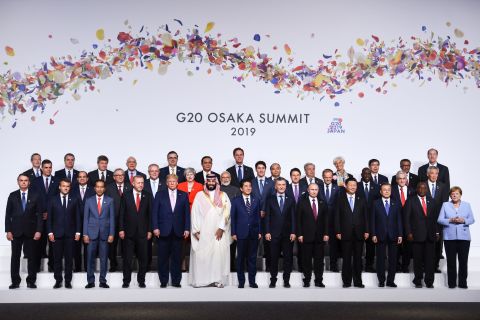
G20 official picture: the messages
Some
people will spend a bit of their time reading the official picture of the 2019
G20 Meeting just held in Osaka. These types of pictures contain many hints.
They cannot be taken lightly. The protocol and the political seniors of the
host country – in this case, the Japanese who are masters in matters of meaning
and symbology – invest a lot of working days deciding the positioning of
everyone in the picture. Their final choice has a deep political import.
This
year’s photo gives special attention to the Saudi Crown Prince Mohammed bin
Salman. He stands at the centre, between the host, Prime Minister Shinto Abe,
and the US President. We could think that such placing might be related to the
fact that Abe is just back from a visit to Iran and he wanted to show that he
also pays special attention to the diplomacy towards Saudi Arabia. Maybe he
would love it to be interpreted that way. But it is just a happy coincidence
for the Japanese. Abe is close to the Crown Prince because Saudi Arabia will be
organising the next G20 Meeting, in November next year.
That’s
the reason why the President of Argentina, Mauricio Macri, is also on the front
row. The last meeting took place in his country (2018). That’s protocol.
Then,
the rest of the front row brings together some of usual suspects: the leaders of
China, Russia, Germany and France. But also, some special friends of Japan.
First, two close neighbours, South Korea and Indonesia. And three other
countries representing other regions of the world: Brazil, Turkey and South
Africa. Surprising is to see Prime Minister Modi emerging in the second row.
That’s not where India should be.
On
the last row, a bit lost as he looks in the wrong direction, we can find the UN
Secretary-General. This is not new. It has nothing to do with António Guterres.
To place the UN boss in the background has been the tradition. I always thought
such positioning sends a very inappropriate signal. The UN must be better
recognised by the world leaders, particularly in a meeting that deals with
global issues. It is important to battle for that.
In
the end, my overall assessment of the meeting is positive. Many people might
say these summits have no real purpose and are not useful. That’s a respectable
way of looking at them. I want to take the opposite view, particularly in
respect of this one. We are living in a period of tensions and great
complexities. These leaders have the power to make it go in the right
direction. They represent most of the world’s population and 85% of the global
economy. When they meet and send some positive messages, the world feels a
little bit more hopeful.
Thursday, 27 June 2019
European Defence and Security
Brief
answers to questions about the EU defence and security:
First,
it is obvious that NATO remains the strongest defence option for the Europeans.
It is a powerful structure, it has invested a lot on training and change, it is
well known in the European military circles, and several EU member States see
it as the key umbrella. They think that without the might of the Americans, the
EU defence is not strong enough.
Second,
several EU leaders think that Europe should have its own common defence
capacity and that such capacity should be in place in 10 to 15 years’ time. For
that to happen, its building must start now, which means more joint EU military
activities, more coordination, joint defence industries, shared means, and so
on. This option will keep growing but the pace might be slow.
Third,
the EU geopolitical interests and views are becoming divergent of those pursued
by the US. That is true in Middle East, that is also the case regarding our
relations with China, and India, and so on. Diverging interests mean that
sooner or later we must be able to put together an independent capability.
Fourth,
the EU are afraid of being dragged into conflicts that are only in the interest
of the US. They are afraid of a deeper confrontation between the US and China.
The EU does not want to automatically take sides on such dispute, if it occurs.
Wednesday, 26 June 2019
The UN and the current crises
The
United Nations is always required to be politically smart. That’s the way I saw
it, when performing the responsibilities that had been assigned to me. And that’s
what I still believe to be the best approach. Smart means above all to be able
to say what must be said but with the words that build trust and show concern. Timidity
is not the best road to achieve results and guaranty the necessary credibility.
I
mention it because today I had to state that things must get better. If the UN
remains basically inspired by risk aversion, it will keep pushing itself to the
margins of the key current issues.
The
Member States must be reminded, as often as the opportunity arises and as it is
authorised by the UN Charter and by the history of the organisation, that they
ought to support the central role the UN is supposed to play in case of international
crises and conflicts. They should also be helped to keep in mind – and act
accordingly – that any conflict resolution situation and peacebuilding effort
require a comprehensive response. The UN System has the know-how to provide
comprehensiveness. And the System must say it loud and clear. It should also
smartly – diplomatically – challenge those leaders who keep betting on a
security solution to complex crises. A security response, even a powerful one,
is just a tool. It is not the master key.
Monday, 24 June 2019
Leadership and renewal
I
spend a bit of time talking about leadership in the context of strategy
formulation and implementation. The quality of the leader determines the excellence
of the strategy. Very often we forget that fact. We look at the strategy but do
not consider the merit of those in charge of designing it, of talking about it
to do the convincing part, and of its operationalisation.
We
have also to keep in mind that leaders emerge, and grow but that one day, they
must go and leave room for the next generation. The rotation issue is an
important one. It keeps the creativity on. Therefore, true leaders must prepare
the new crop that will end up by taking over. This is an evidence that is often
ignored. By the leaders themselves, first.
Subscribe to:
Posts (Atom)